
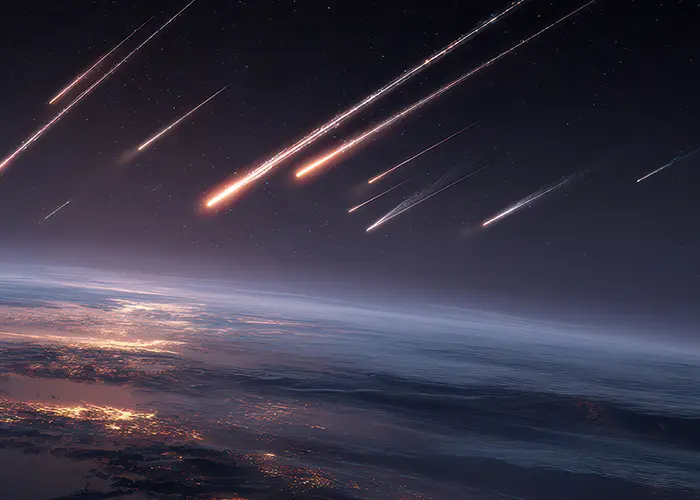
New research led by Curtin University and QUT suggests repeated asteroid impacts during the Hadean period more than four billion years ago delivered significant heat into Earth’s interior, delaying the formation of stable continents.
The study argues early Earth was struck far more frequently than today, with each impact injecting energy deep into the planet. The researchers say the result was a hotter, weaker and more unstable planet than some models of early Earth assume.
Lead author Professor Tim Johnson, from Curtin’s Frontier Institute for Geoscience Solutions in the School of Earth and Planetary Sciences, said the work challenges the view that large impacts were primarily short-lived surface events.
“There is a temptation to think of large impacts as short-lived events that scar a planet’s surface and then pass,” Professor Johnson said.
“But the early Solar System was full of collisions, and the Moon preserves that history in plain sight. Those impacts carried enormous amounts of energy, and that energy had to go somewhere.
“The extra heat from impacts would have kept much of the early crust weak and partially molten, making it difficult for rocks to survive.
“At the same time, those conditions would have helped produce more silica-rich crust, which later became the foundation of the continents.”
Co-lead author Professor Craig O’Neill, from QUT, said modelling conducted by the team indicated the effects of impacts persisted well beyond the moment of collision, with heat transferred into the mantle beneath and around impact sites.
“On the early Earth, much of that energy would have been transferred into Earth’s mantle, the thick layer immediately beneath the crust, as heat,” Professor O’Neill said.
“That would have caused mantle beneath and around the impact site to rise and melt, producing large volumes of magma.
“Our results suggest the early crust was thin and unstable for much of the Hadean, not a world with strong plates behaving in a familiar modern way.
“Instead, impacts would have helped keep the crust hot, weak and mobile, while driving melting and recycling on a planetary scale for tens to hundreds of millions of years after the initial collision.”
The researchers say the findings may help explain why almost no rocks survive from the first 500 million years of Earth’s history, and why long-lived continents appear to have formed only after impact intensity declined.
Professor Johnson said lunar evidence suggested that by around 3.9 billion years ago the global effect of impact heating became less important, which he said aligns with when Earth begins to preserve continental crust.
“It is apparent from the Moon that, by around 3.9 billion years ago, the global effect of impact heating becomes much less important, which is also around the time Earth begins to preserve continental crust. That seems unlikely to be a coincidence,” Professor Johnson said.
Macquarie University also contributed to the study, titled ‘Impact heating and the hidden Hadean’, published in Science: https://doi.org/10.1126/science.aeb540.