
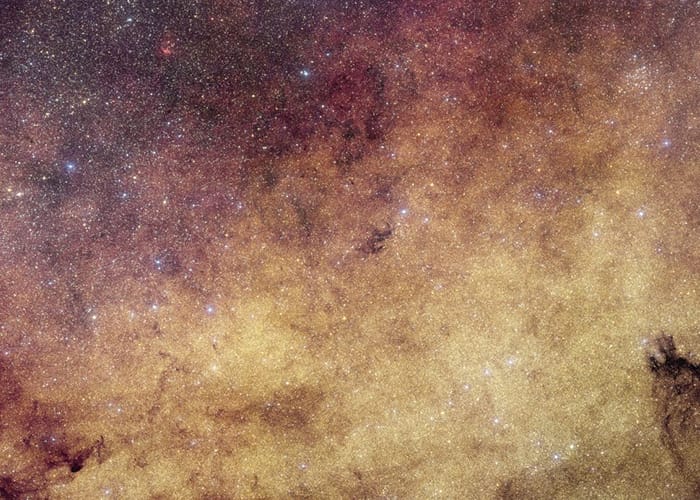
The European Space Agency (ESA) says its Euclid space telescope has captured what it describes as the largest and most detailed visible-light image of the Milky Way’s centre, a mosaic containing more than 60 million stars.
ESA said the image, released on 24 June 2026, focuses on the galaxy’s inner region known as the galactic bulge. Although Euclid was designed to observe distant galaxies as part of its dark matter and dark energy survey, astronomers requested the additional observation to take advantage of the mission’s ability to image wide areas of sky with high resolution.
According to ESA, Euclid collected the data on 23 March 2025 over about 26 hours, producing a mosaic of nine pointings from its visible-light camera (VIS). ESA said each pointing covers an area of sky larger than the full Moon.
ESA compared Euclid’s visible-light sharpness and sensitivity to the NASA/ESA Hubble Space Telescope’s wide field camera, while noting Euclid’s field of view is far larger. It said capturing a comparable mosaic would require around 2000 hours using the Keck Observatory. The agency also said the same mosaic covers the region the upcoming Roman space telescope is expected to monitor for planet hunting.
ESA said the image is expected to support studies of exoplanets using gravitational microlensing, a method that detects planets when a foreground star passes in front of a background star and its gravity magnifies the background starlight. If a planet orbits the foreground star, its additional gravity can create a small, uneven change in the brightening, revealing the planet’s presence.
“To catch microlensing, you need to observe parts of the sky that are crowded with stars, such as close to the centre of our galaxy,” said Jean-Philippe Beaulieu of the Institut d’Astrophysique de Paris and the University of Tasmania, who ESA said helped initiate Euclid’s galactic bulge survey and co-led the exoplanet working group of the Euclid Consortium.
Beaulieu said that over the past 20 years almost 300 exoplanets have been discovered using microlensing with ground-based telescopes, and that the Euclid image includes 51 known planetary systems.
While ESA said Euclid’s one-day observation is not sufficient to detect new microlensing events—which can require monitoring a star for more than 20 days—it said the dataset could help scientists measure the masses of planets that have already been identified and those found in future surveys.
“In 24 hours, Euclid has already captured the stars involved in all the future microlensing events that the Roman space telescope will detect, but before the stars and planets involved have aligned,” said Natalia Rektsini of the Institut d’Astrophysique de Paris, who ESA said led the release of Euclid’s galactic bulge survey data.
Rektsini said Euclid’s ability to distinguish individual stars could enable researchers to use the image as a historical reference to measure stellar motions over time and help confirm planets and determine their mass.
ESA said the dataset could also be used for other astronomy research including brown dwarfs, binary stars, stellar motions and dust across the Milky Way.
Euclid was launched in July 2023 and began routine science observations on 14 February 2024. ESA said the mission will run for six years and aims to observe the shapes, distances and motions of billions of galaxies out to 10 billion light-years to investigate the influence of dark matter and dark energy.