
NASA has assigned four crew members from three space agencies to its SpaceX Crew-13 mission, which is set to launch no earlier than mid-September for a long-duration expedition aboard the International Space Station.
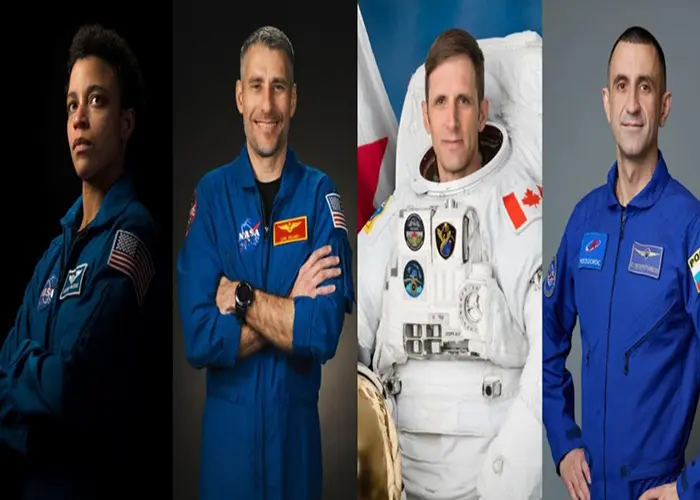
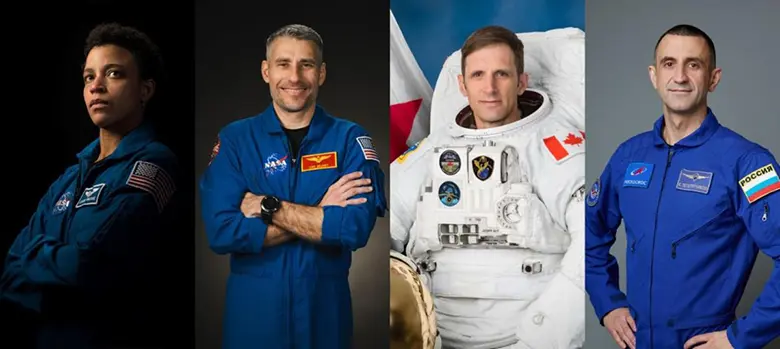
The agency said NASA astronauts Jessica Watkins and Luke Delaney will serve as spacecraft commander and pilot, respectively. They will be joined by Canadian Space Agency astronaut Joshua Kutryk and Roscosmos cosmonaut Sergey Teteryatnikov as mission specialists. After arriving at the station, the crew is expected to join Expedition 75.
Crew-13 will be the 13th crew rotation flight to the station under NASA’s Commercial Crew Program. NASA said it is moving the mission’s launch date forward from November to mid-September to increase the frequency of U.S. crew rotation missions to the orbiting laboratory.
The mission will be Watkins’ second trip to the space station, following NASA’s SpaceX Crew-4 mission in 2022, when she spent 170 days in space across Expeditions 67 and 68. NASA said she will become the first agency astronaut to launch aboard a SpaceX Dragon spacecraft twice.
For Delaney, Kutryk, and Teteryatnikov, Crew-13 will be their first spaceflight. NASA said Delaney was selected as an astronaut in 2021 and previously served as a naval aviator, test pilot, and research pilot at NASA’s Langley Research Center. Kutryk, selected by the Canadian Space Agency in 2017, previously flew CF-18 fighter missions and worked as an experimental and operational test pilot in Canada. Teteryatnikov, selected for the Gagarin Research and Test Cosmonaut Training Center Cosmonaut Corps in 2021, has served as a test cosmonaut since 2023.
NASA said the crew will conduct scientific investigations and technology demonstrations during their time on the station, work it said is intended to support future exploration missions while continuing research in low Earth orbit.
The International Space Station has been continuously inhabited for more than 25 years, NASA said, and is used to support research not possible on Earth and to study the challenges of long-duration human spaceflight.