
LatConnect60 says it has started a growth investment round aimed at accelerating development of a short-wave infrared (SWIR) satellite constellation, as the company positions the project for dual-use applications aligned with AUKUS priorities.
The Perth-based Earth observation and AI company said the funding effort builds on initial support from the Australian Space Agency and the Western Australian Government, with plans to progress from two SWIRSAT missions to an 18-satellite constellation and, ultimately, to a planned 100-satellite network by 2035.
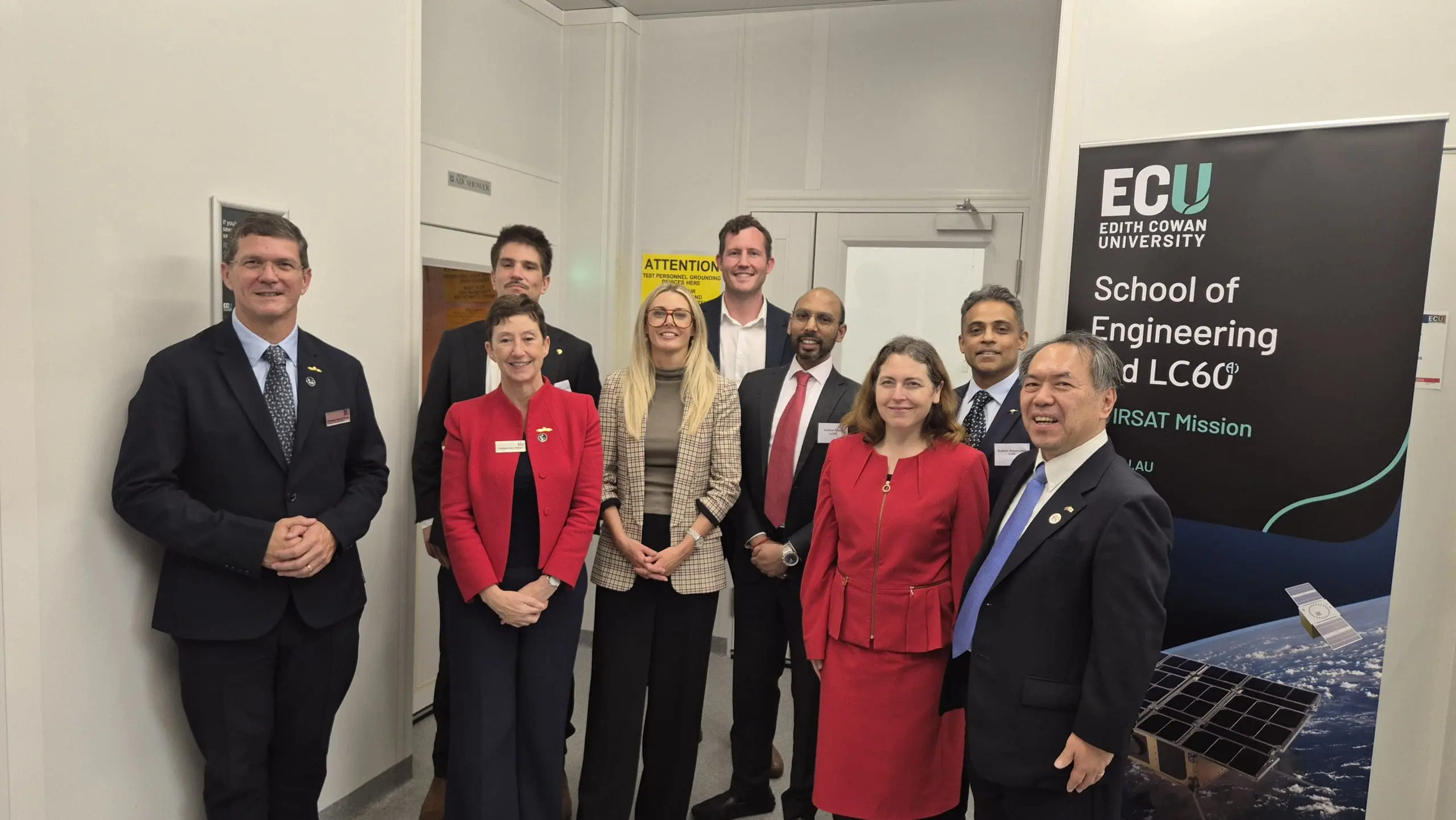
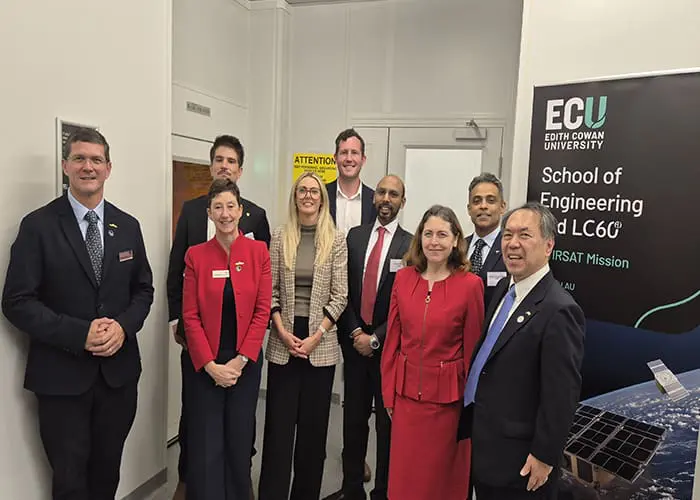
Image: From Left to Right: 1. Prof. Paulo De Souza, Deputy Vice Chancellor, ECU 2. Prof. Clare Pollock, Vice Chancellor ECU 3. Rhodri Biggs, Western Australian State Government 4.Caitlin Collins MLA, Parliamentary Secretary for Defence Western Australia 5. Venkat Pillay, CEO & Founder LC60 6. Colleen Altstock, USA Consul-General 7. Rueben Rajasingam, COO & Co Founder LC60 8. Atsushi Karimata, Japan Consul General
LatConnect 60 said investors in late-stage discussions to cornerstone the round by end of June include allied government investment funds and corporate venture capital firms. It did not disclose a target amount or valuations for the round.
The announcement was made on 21 May at the opening of Edith Cowan University’s Space Integration Facility, in an ECU–LatConnect 60 event attended by Western Australian Parliamentary Secretary for Defence, Caitlin Collins, along with US Consul-General Colleen Alstock and Japan Consul-General Atsushi Karimata, the company said.
Chief executive and founder Venkat Pillay said the company is moving from demonstration missions to a larger-scale constellation, with two satellites planned for launch in Q1 2027. “We are building the first Australian-led, AUKUS aligned SWIR intelligence layer at scale; the two satellites for launch in Q1 2027 are just the starting point,” he said.
LatConnect 60 said its longer-term objective is to increase availability of SWIR imagery, targeting sub-1 metre resolution at scale. SWIR imagery is used to detect material, moisture and surface-condition signatures that may not be visible in standard imagery, with potential applications across agriculture, sustainability and environmental monitoring, and defence and national security use cases including maritime awareness, concealment detection, infrastructure monitoring and post-event assessment.
The company linked the roadmap to Australian and allied defence priorities, citing sovereign capability and resilient, AI-enabled space architectures, including areas emphasised under AUKUS Pillar II such as maritime domain awareness and information sharing.
LatConnect 60 said it intends to anchor parts of spacecraft integration and workforce development in Western Australia via ECU’s new facility, which it described as supporting local integration, cleanroom operations and technical training. “Sovereignty is not just about owning a satellite,” Pillay said. “It is about controlling the chain; tasking, downlink, processing, AI models, product generation and authorised dissemination.”
LatConnect 60 said it already has civilian customers in agriculture and sustainability-focused platforms, including programmes supporting more than 125,000 smallholder farmers across Southeast Asia. The company said agriculture and sustainability represent its scale opportunities, while defence and allied offtake are a growing area.