
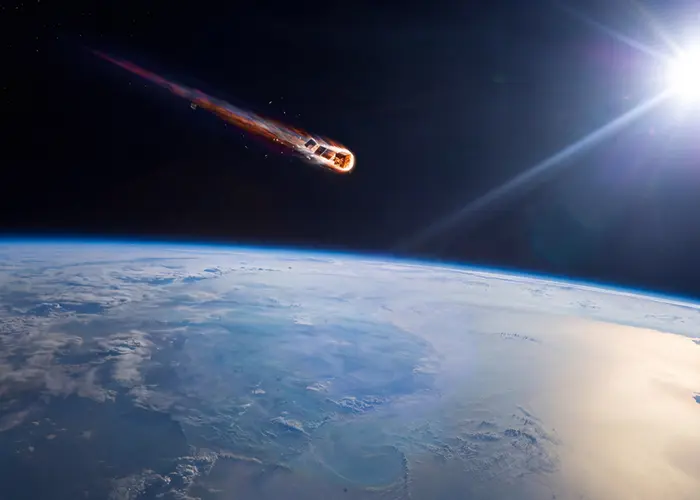
Astroscale Holdings Inc. has launched a new industry–academia collaboration aimed at improving scientific understanding of how spacecraft reentry affects Earth’s atmosphere.
The initiative, called Atmospheric Impact of Reentered Spacecraft (AIRS), includes Planet Labs PBC and the University of Southampton as founding participants. Astroscale said the collaboration is intended to help address gaps in data and modelling as the number of satellites reentering the atmosphere is expected to increase with accelerating activity in low Earth orbit.
While space sustainability efforts have largely focused on in-orbit operations and debris removal, the atmospheric effects of reentry have been less studied, according to the company. During reentry, spacecraft materials can melt, fragment and vaporise as they interact with atmospheric gases, releasing compounds at different layers of the upper atmosphere. Astroscale said these processes are difficult to measure directly and challenging to model.
Astroscale said current simulations often rely on simplified assumptions because detailed spacecraft manufacturing data is not widely available to researchers, potentially limiting the relevance of academic models.
Under AIRS, space operators and manufacturers will be able to share non-proprietary spacecraft design information with academic researchers, with the stated goal of improving the accuracy of atmospheric modelling while protecting commercially sensitive data. Astroscale said participants may share information such as material composition and approximate mass breakdowns under confidential bilateral agreements, with more detailed data—such as component layouts or expected reentry profiles—shared at the participant’s discretion.
“Spacecraft reentry has long been treated as an optimal mission endpoint, but it is increasingly clear that we need a deeper scientific understanding of what happens during this phase,” said Mike Lindsay, Chief Technology Officer at Astroscale. “By enabling industry to contribute real-world data in a trusted way, AIRS removes critical barriers for atmospheric research and ensures space sustainability is guided with the most accurate and up-to-date information.”
Astroscale said it will coordinate the initiative and contribute its own spacecraft data alongside Planet. It said Planet will contribute expertise in Earth observation, including satellite manufacturing and operations, while the University of Southampton will provide research capabilities in aerospace engineering and atmospheric science.
“Our mission to make global change visible starts with a deep responsibility for the space environment in which we operate,” said James Mason, Chief Space Officer at Planet. “Sustainable space operations must account for a satellite’s entire lifecycle, including its eventual reentry. By providing data to the AIRS initiative, we are helping the scientific community move past simulations and toward a factual, data-driven understanding of our industry’s atmospheric footprint.”
“A primary challenge in assessing the effects of re-entry emissions on the upper atmosphere is the scarcity of high-quality data required for robust modelling and evidence-based analysis,” said Minkwan Kim, Professor at the University of Southampton, UK. “AIRS will address this critical gap, improving our understanding and mitigation of atmospheric re-entry ablation impacts, and ensuring that the benefits of space remain accessible to future generations.”