

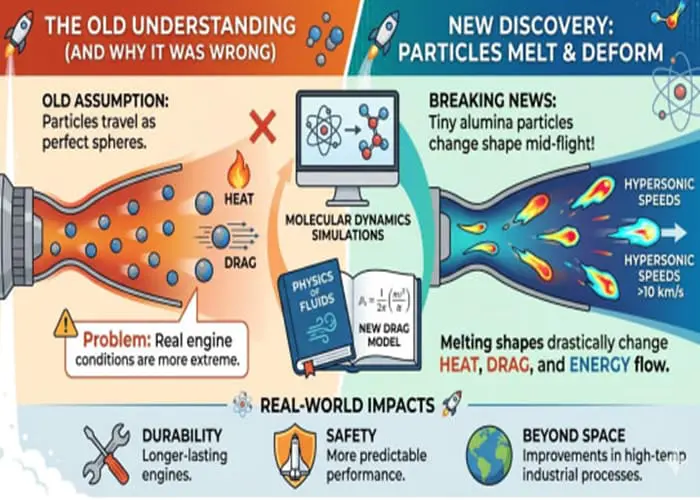
New research from Monash University suggests microscopic particles formed inside solid rocket motors can melt and deform at hypersonic speeds, challenging long-standing engineering assumptions and potentially influencing future spacecraft and defence propulsion design.
According to the study, particles travelling at hypersonic speeds do not remain spherical, instead changing shape mid-flight in ways that affect heat transfer, drag and energy movement through rocket systems. The findings were published in Physics of Fluids, with researchers developing a new drag model intended to better predict particle behaviour under extreme conditions.
Co-author Associate Professor Qijun Zheng from Monash Mechanical and Aerospace Engineering said the work provides insight into how particles interact with air in high-temperature, high-pressure environments found inside rocket engines. “Inside rocket motors, these nanoparticles are exposed to enormous temperatures, pressures and speeds,” he said. “Our simulations show that once particles reach hypersonic speeds, they can rapidly heat up, melt and even dramatically change shape while travelling through the airflow.”
The research focused on alumina nanoparticles produced when aluminium fuel burns in solid rocket motors. Although far smaller than a human hair, the particles can travel at up to 10 kilometres per second through rocket nozzles. The team used molecular dynamics simulations—atom-by-atom computer modelling—to track their behaviour in high-temperature, high-pressure air.
The study found slower-moving particles remained relatively stable, while particles at extreme speeds experienced intense collisions with surrounding air molecules that caused rapid heating and melting. Researchers also reported that smaller particles heated faster due to their higher surface-area-to-volume ratio, and that molten particles could stretch into thin “bag-like” structures before collapsing into new forms during flight.
Associate Professor Zheng said these shape changes matter because they influence energy transfer and turbulence in the flow, affecting predictions about wear and performance inside rocket systems. “Current engineering models often assume particles remain perfectly spherical, but our work shows that assumption no longer holds under these extreme conditions,” he said.
The researchers said the findings could be relevant beyond rocket propulsion, including atmospheric re-entry, energy systems and other industrial processes involving nanoparticles in high-temperature conditions. The study was led by researchers from the Southeast University–Monash University Joint Research Institute, Monash University and Shanghai University.
The research paper is available at: https://doi.org/10.1063/5.0321480