
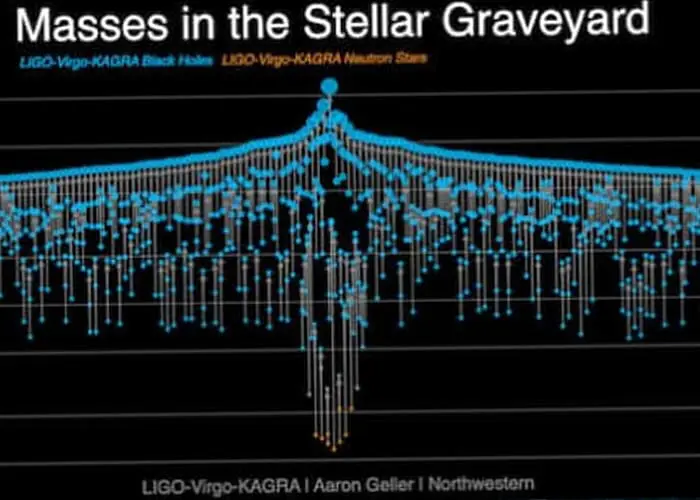
The LIGO-Virgo-KAGRA (LVK) Collaboration has released an updated catalogue of gravitational-wave detections, adding hundreds of observations of collisions involving black holes and neutron stars.
Researchers from the LVK collaboration and Monash University say analysis of the latest release, the Gravitational-Wave Transient Catalog (GWTC-5.0), points to evidence that binary black holes form through multiple distinct pathways rather than a single dominant process.
The catalogue draws on data collected by the two US-based Laser Interferometer Gravitational-wave Observatory (LIGO) detectors and the Virgo detector. Gravitational waves are ripples in spacetime produced by violent astrophysical events such as mergers of compact objects.
Monash University research fellow Sharan Banagiri, who led the project, said the dataset contains nearly 400 detections and shows patterns in the population of merging systems.
“This set of nearly 400 gravitational-wave detections from LIGO and Virgo provides us with a clear indication that the binary black hole mergers we see are forming in several different ways. Some might form as one giant cloud of gas that collapses to give two massive stars that then become black holes. Others might be black holes that wander into each other in dense environments called clusters that are packed with stars. While others are the product of a previous generation of mergers between two black holes,” Dr Banagiri said.
The team’s paper, released as a preprint, reports multiple sub-populations of merging black holes that may be linked to different formation channels.
Princeton University assistant professor Sylvia Biscoveanu, a co-author of the study and a former Fulbright postgraduate scholar at Monash, said the latest catalogue update is a significant expansion and includes events with unusual characteristics.
“GWTC-5 represents the largest single increase in the size of the gravitational-wave catalogue, including events with remarkable properties such as GW241127, which contains black holes of very different masses with clearly wobbling orbits due to tilted spins. The new catalogue also contains the event with the best localisation on the sky to date, GW240615.”
Among the new findings, the researchers report evidence that some black holes in the catalogue are spinning rapidly. They said the fast-spinning population appears to split into two mass ranges: black holes of about 10 to 20 times the Sun’s mass, and another group above about 45 solar masses.
“One of the most fascinating things we’ve discovered about these new black holes is that they are spinning very fast. The sun rotates once every 25 days. If it became a black hole and started spinning as quickly as the ones we discovered, it would be rotating several thousand times every second. So where do these rapidly-spinning black holes come from? One leading explanation is that they are ‘hierarchical’ products of a previous generation of merger between two black holes,” Dr Banagiri said.
The paper also argues that black holes formed through hierarchical mergers tend to be more massive than others in their local population, and that objects above about 45 solar masses are more likely to merge with lower-mass black holes.
Monash University professor Eric Thrane, a chief investigator at the ARC Centre of Excellence for Gravitational Wave Discovery (OzGrav), said the growing catalogue is shifting the field from individual detections to population-level analysis.
“We are no longer just looking at individual anomalies, instead, we are seeing a true kaleidoscope of cosmic collisions. We are pushing the edges of what we know, seeing things that are more massive, spinning faster, and more unusual than ever before,” Professor Thrane said.
The research paper is available at https://dcc.ligo.org/LIGO-P2600045/public.