
Representatives from European Space Agency (ESA) Member States have agreed to extend 13 science missions and to adopt a new “fast-class” mission, Arrakihs, following a meeting of ESA’s Science Programme Committee in Tenerife on 10–11 June.
The Committee, which includes representatives from each of ESA’s 23 Member States, oversees ESA’s mandatory Science Programme and makes decisions on the future direction of European space science. ESA said the latest decisions and discussions will shape the programme “throughout the 2030s and beyond”.
ESA’s Director of Science, Professor Carole Mundell, said: “Being motivated by the scientific community means that we can build world-leading space missions that really meet the needs of European scientists. Our aim is to provide the best missions possible to encourage technological innovation and scientific discoveries across our Member States.”
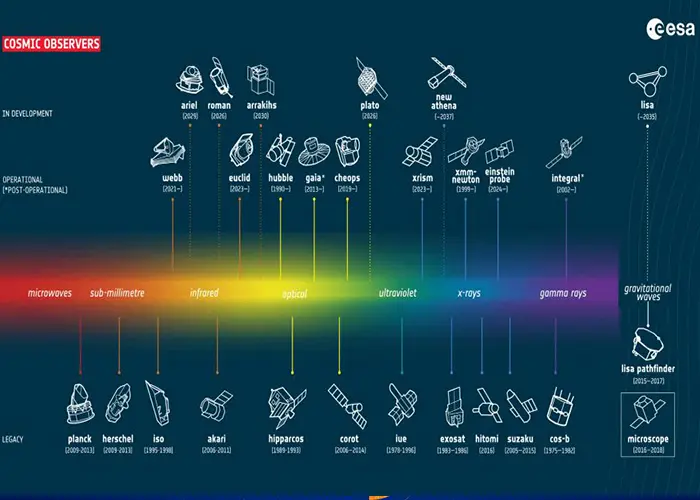
The Committee endorsed extensions for all 13 missions that are due to end their current science phase before the end of 2026. ESA said mission extensions are typically based on whether spacecraft can continue to return new scientific results beyond an initial operations phase that can last up to five years.
The missions approved for extension are BepiColombo, Cheops, Einstein Probe, Hinode, Hubble, IRIS, Mars Express, Proba-3, SOHO, Solar Orbiter, Webb, XMM-Newton and XRISM.
ESA said the extension was particularly significant for Solar Orbiter, launched in 2020, which is studying the Sun at close range and has returned initial observations of the Sun’s poles. ESA said continued operations would support higher-latitude observations and additional science.
Separately, the Committee approved adoption of ESA’s second “fast-class” mission, Arrakihs, a step ESA said commits the agency and its Member States to building and launching the spacecraft. Arrakihs is designed to measure faint light from the haloes of stars and gas around galaxies, with ESA describing it as a mission aimed at addressing questions about cosmic history. ESA said the mission is expected to launch by the end of 2030 and noted a leading role for Member States, “particularly Spain”, in developing the mission.
ESA also provided an update on its next medium-class mission selection process. Based on assessments of three shortlisted candidates, ESA has proposed the Plasma Observatory as the next medium-class mission. The Science Programme Committee took note of the recommendation, with a formal decision scheduled for the Committee’s next meeting in November 2026.
According to ESA, Plasma Observatory would study how plasma from the Sun interacts with Earth’s magnetosphere, including how energy is transferred and distributed through the system. ESA said the mission concept involves a constellation of seven spacecraft, intended to observe interactions across multiple space and time scales simultaneously.