

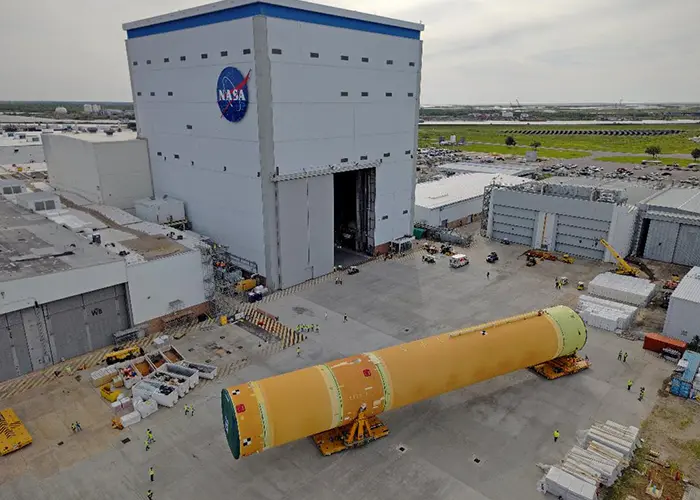
NASA has moved the core stage of the Space Launch System (SLS) rocket that is planned to launch the crewed Artemis III mission in 2027, shipping the hardware from the agency’s Michoud Assembly Facility in New Orleans to the Pegasus barge for transport to Kennedy Space Center in Florida.
The rollout follows NASA’s Artemis II test flight around the Moon, which the agency described as successful. NASA said the transfer of the core stage marks progress toward its next crewed lunar mission under the Artemis program.
Engineers used specialised transporters to move the top four-fifths of the core stage—containing the liquid hydrogen tank, liquid oxygen tank, intertank and forward skirt—from inside Michoud to the Pegasus barge. After it arrives at Kennedy, teams will complete outfitting and vertical integration, and NASA’s Exploration Ground Systems Program will stack the rocket’s components ahead of launch.
“Seeing this SLS rocket hardware roll out is a powerful reminder of our progress toward returning humans to the lunar surface,” said Lori Glaze, acting associate administrator, Exploration Systems Development Mission Directorate at NASA Headquarters in Washington. “This is the backbone of Artemis III. As it heads to Florida for final integration, we are one step closer to testing the critical capabilities needed to land Americans on the Moon, and ultimately, paving the way for our first crewed missions to Mars.”
The completed core stage is expected to stand 212 feet tall once joined with its engine section. NASA said the two propellant tanks hold more than 733,000 gallons of super-chilled liquid propellant to fuel four RS-25 engines, and that the fully integrated stage will operate for more than eight minutes during launch and ascent, producing more than 2 million pounds of thrust to send the Orion spacecraft into orbit.
NASA said the core stage work involves prime contractors Boeing, responsible for overall design and assembly of the core stage, and L3Harris Technologies, which the agency said manufactures the rocket’s RS-25 engines. The agency also pointed to recent announcements by NASA Administrator Jared Isaacman aimed at standardising the SLS configuration, streamlining operations and optimising production.
NASA said Artemis III will launch astronauts to Earth orbit aboard Orion atop SLS to test rendezvous and docking between Orion and commercial spacecraft. The agency linked those tests to preparations for landing Artemis IV astronauts on the Moon in 2028, and said SLS is the only rocket capable of sending Orion, astronauts and supplies to the Moon in a single launch.
Image credit: NASA/Michael DeMocker.