

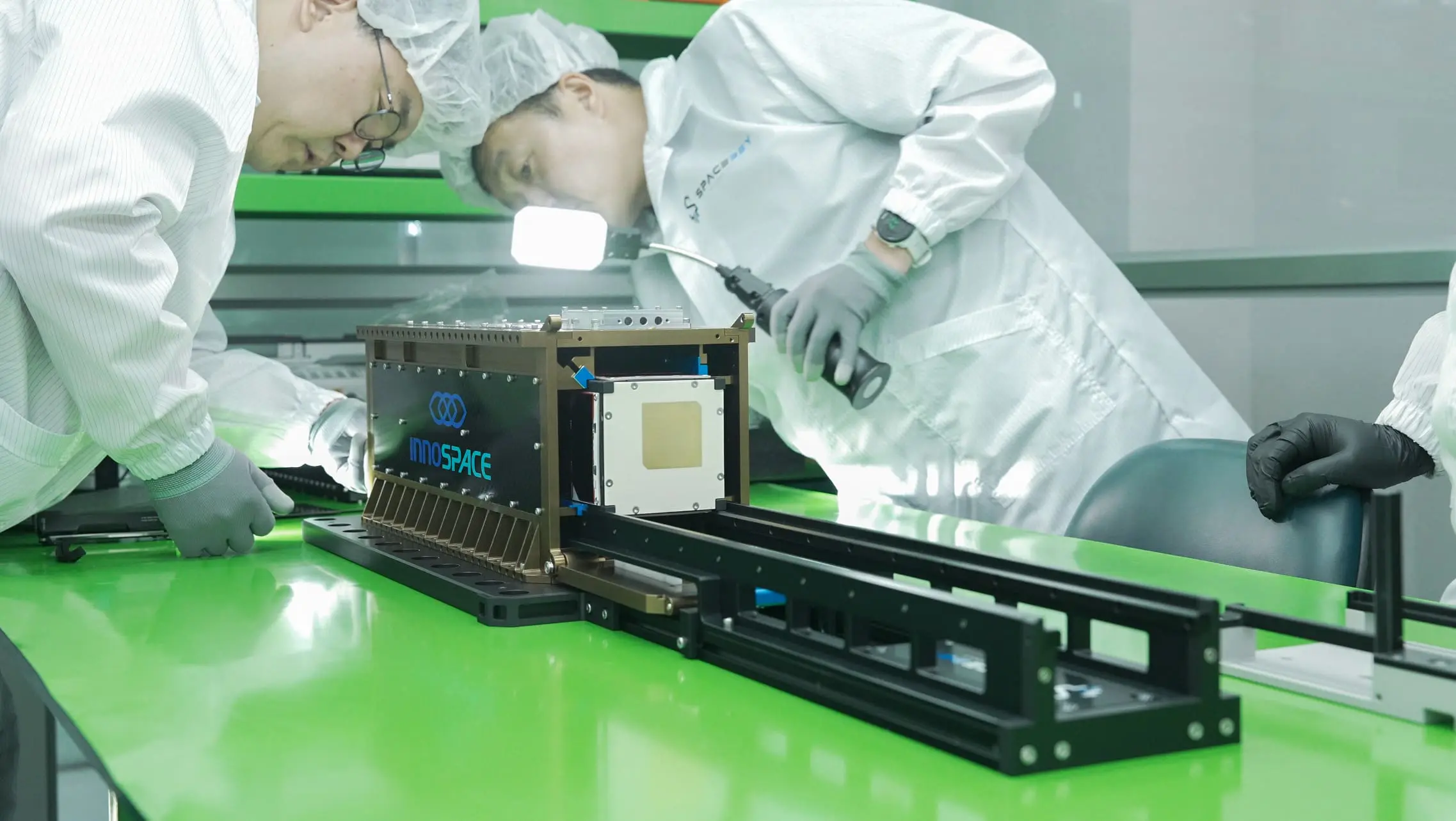
South Korean launch company INNOSPACE says it will integrate a satellite deployer from local firm SpaceBey for the second launch of its HANBIT-Nano vehicle, scheduled for the third quarter of 2026 at the Alcântara Space Center in Brazil.
The company said the mission will carry its first in-house test satellite, InnoSat-0, using SpaceBey’s deployer. INNOSPACE described the arrangement as an effort to integrate the launch vehicle, satellite and deployer system within South Korea’s space industry.
According to INNOSPACE, the deployer serves as the mechanical and electrical interface between the satellite and launch vehicle and is intended to support stable separation in orbit. The company said the collaboration will focus on design verification, testing and integration to support launch readiness.
SpaceBey, founded in 2017, develops nanosatellite deployers and separation systems. INNOSPACE said SpaceBey’s 6U-class deployer, SPOD6, was flown on the fourth launch of South Korea’s Nuri-ho (KSLV-II) in 2025, and that its next-generation separation technology is designed to be non-explosive to reduce vibration and rotational disturbance.
“We are pleased to prepare for the launch of our first test satellite, InnoSat-0, in collaboration with SpaceBey, a partner with proven technical expertise,” said Soojong Kim, Founder and CEO of INNOSPACE. “We will continue to expand technical cooperation with domestic space companies to accumulate mission experience and grow alongside the Korean space industry ecosystem.”
The companies said they are conducting integration tests at INNOSPACE’s Cheongju Campus in North Chungcheong Province, including verification of mechanical and electrical synchronisation and separation sequences under simulated launch conditions.
INNOSPACE said HANBIT-Nano is being developed as a commercial small satellite launch vehicle, and that InnoSat-0 is intended to validate core systems and support future space data services.