

NASA has announced a set of agency-wide initiatives it says are aimed at delivering President Donald J. Trump’s National Space Policy, including changes to its lunar exploration architecture, a revised approach for sustaining a US presence in low Earth orbit (LEO), and a plan to demonstrate nuclear electric propulsion on a Mars-bound spacecraft.
The announcements were made during an “Ignition” event on Tuesday, with NASA Administrator Jared Isaacman framing the measures as a bid to accelerate progress and “clear away needless obstacles” in a period of strategic competition. Associate Administrator Amit Kshatriya said the agency is aligning around a phased, incremental approach to lunar operations and a more deliberate transition plan for post-International Space Station (ISS) commercial stations.
On the Moon, NASA said it will build on earlier Artemis program updates, including standardising the Space Launch System (SLS) rocket configuration, adding an additional mission in 2027, and undertaking at least one surface landing every year thereafter. Under that architecture, NASA said Artemis III (scheduled for 2027) will focus on testing integrated systems and operational capabilities in Earth orbit ahead of the Artemis IV lunar landing.
Looking beyond Artemis V, NASA said it will begin incorporating more commercially procured and reusable hardware to increase the frequency of crewed lunar missions, initially targeting landings every six months, with the possibility of higher cadence as capabilities mature.
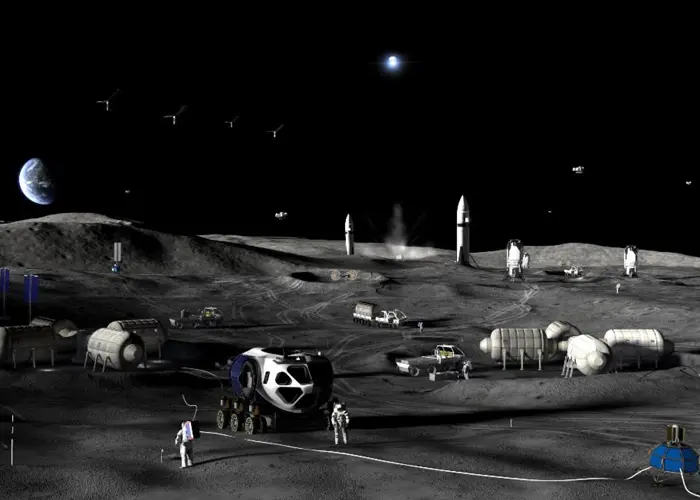
NASA also outlined a shift in how it plans to achieve a sustained lunar presence, announcing a phased approach to building a lunar base and stating it intends to pause the Gateway program “in its current form” to focus on infrastructure enabling sustained surface operations. The agency said it will repurpose applicable equipment and draw on international partner commitments despite what it described as challenges with some existing hardware.
As part of the procurement process, NASA said it will release Requests for Information (RFIs) and draft Requests for Proposals (RFPs) in the coming days.
For a lunar base, NASA described three phases. Phase one focuses on moving from bespoke, infrequent missions to a repeatable, modular approach, using Commercial Lunar Payload Services (CLPS) deliveries and the Lunar Terrain Vehicle (LTV) program to increase activity on the lunar surface. NASA said this phase will support work on mobility, power generation, communications, navigation, surface operations and scientific investigations.
Phase two is intended to establish early infrastructure, including semi-habitable capabilities and regular logistics, with planned international contributions such as JAXA’s pressurised rover and other potential partner payloads and infrastructure.
Phase three would aim to enable long-duration human presence as cargo-capable human landing systems become available, delivering heavier infrastructure for a continuous foothold and transitioning from periodic expeditions to a permanent lunar base. NASA cited potential partner contributions including ASI’s Multi-purpose Habitats and CSA’s Lunar Utility Vehicle.
In LEO, NASA said it remains committed to the ISS while acknowledging that the station “cannot operate indefinitely.” The agency outlined an additional strategy that preserves existing pathways while adding a phased approach anchored to the ISS to avoid a gap in US human presence and support development of commercial stations.
Under that approach, NASA said it would procure a government-owned “Core Module” attached to the ISS, followed by commercial modules validated using ISS capabilities before detaching into free flight. The agency said NASA would ultimately become one of multiple customers purchasing commercial services once technical, operational and demand conditions mature. NASA said it would also seek to expand industry opportunities, including private astronaut missions, commander seat sales, joint missions, multiple module competitions and prize-based awards. An industry RFI to inform partnership structures, financing and risk mitigation is scheduled to open Wednesday, March 25.
NASA also highlighted a set of current and planned science missions, including the James Webb Space Telescope, Parker Solar Probe and Earth science programs, and referenced future missions including the Nancy Grace Space Telescope, Dragonfly and delivery of ESA’s Rosalind Franklin Rover to Mars with NASA’s contributed mass spectrometer for the Mars Organic Molecule Analyzer instrument. The agency said it is targeting up to 30 robotic CLPS landings starting in 2027 and plans to issue an RFI calling for payloads for additional 2027 and 2028 flights, including payloads supporting lunar research and future Mars missions such as the Mars Telecom Network and a nuclear technology demonstration.
On nuclear power and propulsion, NASA said it will launch Space Reactor-1 Freedom (SR-1 Freedom), described as a nuclear-powered interplanetary spacecraft, to Mars before the end of 2028 to demonstrate nuclear electric propulsion. NASA said the mission will deploy a Mars payload of Ingenuity-class helicopters and is intended to establish flight heritage and regulatory and launch precedent for nuclear hardware, in partnership with the US Department of Energy.
NASA said it is also rebuilding internal capabilities, including converting thousands of contractor positions to civil service, expanding opportunities for interns and early-career professionals, and creating pathways for experienced industry talent through term-based appointments.
As part of implementation, NASA said it will embed subject-matter experts across its supply chain, including major vendors and subcontractors, to address critical path issues and accelerate production while the changes are rolled out over the coming months.