

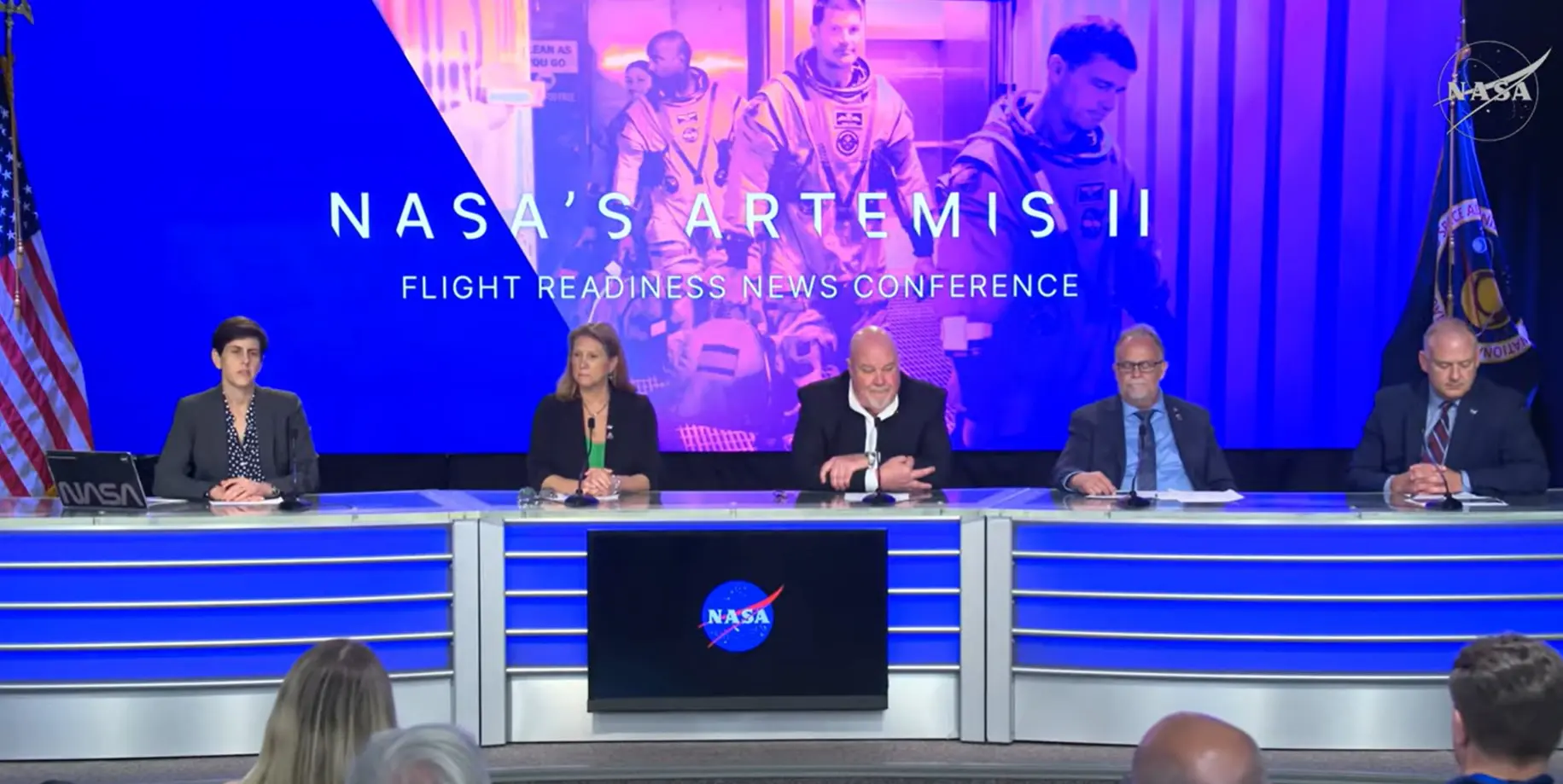
NASA has confirmed that the Artemis II mission has passed a major milestone, with agency officials concluding the Flight Readiness Review (FRR) and preparing for the first crewed mission around the Moon in more than 50 years.
Speaking following the review, NASA managers said the agency is now targeting April 1, 2026 for launch, with an alternate opportunity on April 2, pending completion of final preparations at Kennedy Space Center in Florida.
The Flight Readiness Review represents the final major assessment before launch, examining technical readiness, mission risk, and operational preparedness across NASA and its partners.
Acting Associate Administrator for Exploration Systems Development Lori Glaze said the two-day review involved extensive discussion of mission risks and mitigation strategies.
“The flight readiness review is our final big assessment of our readiness for launch,” she said. “We had extremely thorough discussions about our risk posture, how we’re mitigating those risks, and the work that remains.”
At the conclusion of the review, mission teams unanimously supported proceeding toward launch.
“This is a test flight, and it is not without risk,” Glaze said. “But our team and our hardware are ready.”
Artemis II will send four astronauts – NASA astronauts Reid Wiseman, Victor Glover and Christina Koch, along with Canadian astronaut Jeremy Hansen – on a journey around the Moon before returning to Earth. The mission will mark the first crewed lunar flight since the Apollo programme.
John Honeycutt, chair of the Artemis II Mission Management Team, said the review focused heavily on understanding and communicating risk associated with the mission.
“We ask ourselves repeatedly: is the rocket ready to fly, is the spacecraft ready to fly, and is the integrated team ready?” he said. “This is the first flight of humans to the Moon in over 50 years, and that makes it both historic and incredibly important to get right.”
NASA teams also addressed technical issues that emerged during earlier launch preparations. Two weeks before the review, engineers detected a problem during a wet dress rehearsal involving the upper stage helium system.
Sean Quinn, Exploration Ground Systems programme manager, said engineers traced the issue to a faulty quick-disconnect seal blocking helium flow.
“We X-rayed the component and found a seal blocking the flow of helium,” Quinn said. “Our engineering teams quickly identified the root cause, implemented a design fix, tested it and installed the modified component on the vehicle.”
Additional work has included replacing flight termination system batteries, servicing Orion spacecraft components and completing training exercises for launch crews.
NASA now plans to roll the Space Launch System (SLS) rocket and Orion spacecraft from the Vehicle Assembly Building to the launch pad on March 19.
Mission Control teams in Houston are also completing final preparations.
Norm Knight, NASA’s Director of Flight Operations, said flight controllers have been training alongside the astronauts through extensive simulations.
“Our teams in Mission Control Houston are fully prepared to support this mission,” Knight said. “They’ve worked through countless scenarios to ensure they’re ready to support both the astronauts and the spacecraft systems during the journey around the Moon.”
Astronauts will begin a pre-launch quarantine around March 18 before travelling to Kennedy Space Center approximately five days before launch.
If successful, Artemis II will pave the way for future missions that aim to land astronauts on the lunar surface and establish a sustained human presence around the Moon.
NASA officials emphasised that while the Flight Readiness Review represents a major milestone, the focus remains on completing remaining preparations safely.
“We’re not going to celebrate until we get Reed, Victor, Christina and Jeremy safely home,” Honeycutt said.