

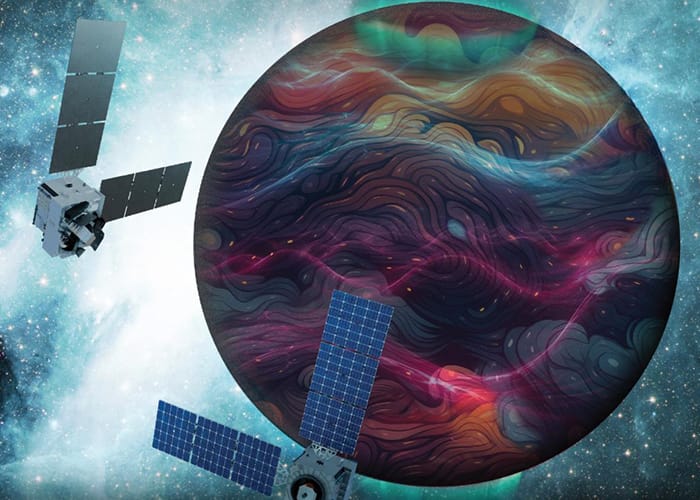
NASA has selected a new mission concept aimed at improving understanding of how space weather and changes in Earth’s atmosphere affect technologies including GPS and low Earth orbit satellites, as well as astronauts in space.
The mission, called DAPHNE (Dynamic Atmosphere-Ionosphere Explorer), will enter Phase B of development, a stage covering detailed planning and design for flight and mission operations. NASA said the concept uses two identical satellites to study how changes in the lower atmosphere influence the upper atmosphere, where space weather effects are observed.
In a statement, Nicky Fox, associate administrator for NASA’s Science Mission Directorate, said the mission is intended to strengthen space weather forecasting and support planning for crewed missions beyond Earth’s magnetic field. “As NASA sends astronauts beyond Earth’s magnetic protection to the Moon, Mars, and beyond, DAPHNE will join the NASA science fleet strategically located across the solar system to provide data that will help mission planners predict and mitigate the effects of space weather for the benefit of all,” Fox said.
NASA said DAPHNE would take coordinated measurements of neutral winds, temperature, and composition in the thermosphere, and focus on the coupled thermosphere-ionosphere system, where the neutral atmosphere transitions into ionised plasma. The agency described these regions as continuously changing due to solar activity, influences from the lower atmosphere, and conditions in near-Earth space.
The mission is led by Aimee Merkel from the Laboratory for Atmospheric and Space Physics at the University of Colorado, Boulder. NASA said funding and management oversight is provided by the Solar Terrestrial Probes program at NASA’s Goddard Space Flight Center in Greenbelt, Maryland, and that the concept was proposed in response to the DYNAMIC (Dynamical Neutral Atmosphere-Ionosphere Coupling) mission announcement of opportunity.
NASA said the mission will undergo a confirmation review in 2027 to assess progress and funding availability. If confirmed, the agency said the total estimated cost, excluding launch, would not exceed US$250 million in fiscal year 2023 dollars, with a launch date no earlier than 2029.