
A University of Adelaide PhD candidate is examining how humans, robots and building materials could work together to construct habitats on the Moon, with a focus on the role of the construction “artifact” itself.
Albert Rajkumar, based at the University’s Andy Thomas Centre for Space Resources, is researching whether building blocks such as bricks should be treated as active participants in the construction process rather than passive materials.
“In most discussions around lunar construction, humans and robots are key, as the human interprets, supervises and intervenes, while the robot executes,” Rajkumar said.
“But I’m currently exploring the idea that the building block, like a brick, is not a passive part of the process, but an active agent in construction.”
Rajkumar said human operators are unlikely to be physically co-located with robots on a lunar construction site, creating new challenges for oversight and decision-making.
He said extended reality (XR) could help link human supervision with robotic activity occurring at a distance, and argued that understanding material behaviour would remain important alongside user interfaces and robot autonomy.
Rajkumar has presented related work in several papers, including research discussed at last year’s International Astronautical Congress in Sydney, according to the University.
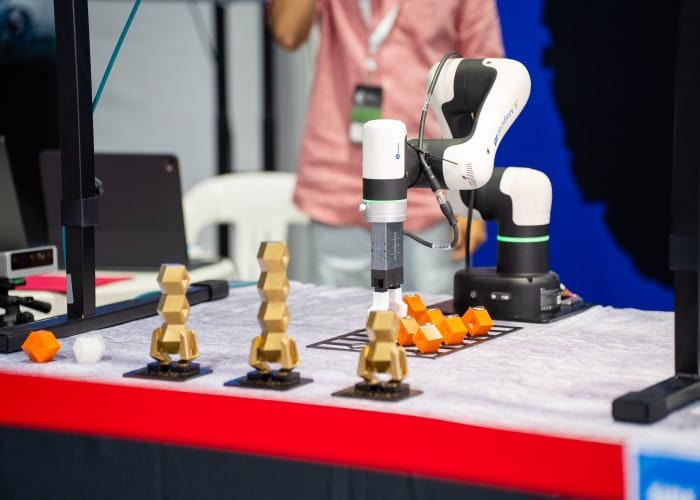
The project was tested at this year’s Australian Rover Challenge at the University’s Roseworthy campus through a “Side Quest” activity. In the demonstration, participants wearing a VR headset faced away from a table containing a robotic arm and blocks, and took on a supervisory role to build the tallest tower possible while immersed in a virtual lunar habitat setting.
“We wanted to demonstrate how robotics and extended reality would work for the purpose of construction,” Rajkumar said.
“This really allowed people to see first-hand how robots, people, and architectural artifacts can work together in this way.”
Rajkumar said the team used the Rover Challenge to connect with students and researchers working in robotics, AI, machine learning and XR, and that it was still looking to build collaborations.
The University said the experiment is now being expanded to a larger-scale build in the CRATER facility at Roseworthy.
“In the long term, we hope this research helps lay the groundwork for how humans and robots might build together – both in space and here on Earth – and uncover what this new architecture might look like,” Rajkumar said.