

The European Space Agency’s (ESA) Science Programme Committee has adopted the Arrakihs mission, clearing it to move from study into development. ESA said the spacecraft is planned for launch by the end of 2030 and will be designed to capture extremely faint light from nearby galaxy haloes to study how galaxies form and evolve.
ESA said adoption indicates the study phase is complete, the mission has been shown to be feasible, and the agency is committing to implement it. The next stage will involve building, integrating and extensively testing the spacecraft and its scientific instrumentation.
Arrakihs is the second “fast” (F-class) mission in ESA’s Cosmic Vision programme, intended to take less than 10 years from selection to launch. ESA said the decision was taken during the Science Programme Committee meeting at the Instituto Astrofísico de Canarias in Tenerife on 10–11 June 2026.
“Arrakihs is a ground-breaking and unique galactic archaeology mission. By uncovering hard-to-see galaxy haloes, it will reveal new details of how galaxies form and whether the Milky Way galaxy is unique. Its rapid development showcases the flexibility and breadth of ESA’s Science Programme,” says Professor Carole Mundell, ESA’s Director of Science.
The mission name is an acronym for Analysis of Resolved Remnants of Accreted galaxies as a Key Instrument for Halo Surveys.
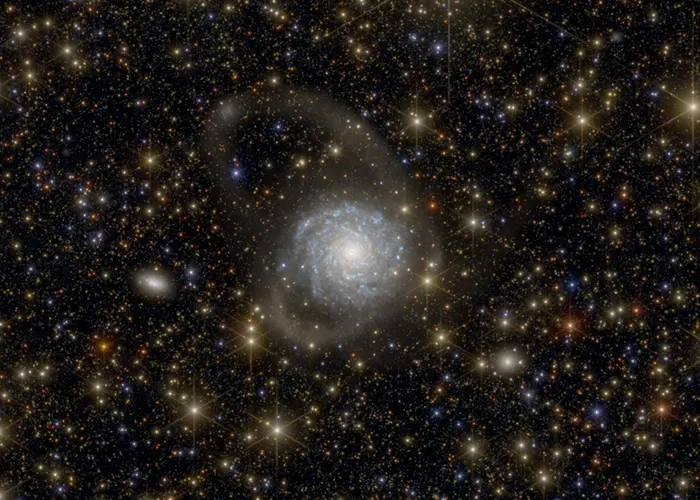
ESA said the mission will focus on galaxy haloes—large, faint regions surrounding galactic discs that contain mostly invisible dark matter as well as stars and hot, charged gas. Arrakihs is expected to observe diffuse stellar haloes and structures such as stellar streams, which ESA described as remnants of smaller galaxies disrupted by gravity.
By mapping stellar streams, ESA said Arrakihs aims to help reconstruct the history of past galaxy mergers and estimate the number of stars stripped during those events. The mission plans to investigate at least 80 galaxies with a similar mass to the Milky Way, which ESA said is intended to provide statistical insight into how a “typical” galaxy forms and whether the Milky Way is unusual.
To detect low surface brightness objects, Arrakihs will carry a single scientific instrument made up of two pairs of “binocular telescopes”, for a total of four cameras. ESA said each camera will cover a different wavelength band, from near-ultraviolet through visible light into near-infrared.
ESA said the instrument is being designed and developed by a consortium of ESA Member States led by Spain, with Switzerland, Austria, Belgium, Norway, Portugal and Sweden as core partners. ESA added that many of the contributions are supported through its Prodex programme.
Arrakihs will join ESA’s fleet of “Cosmic Observers”, which the agency said are aligned to the Cosmic Vision 2015–2025 science themes, including questions around the fundamental physical laws of the Universe and its origins and composition.