

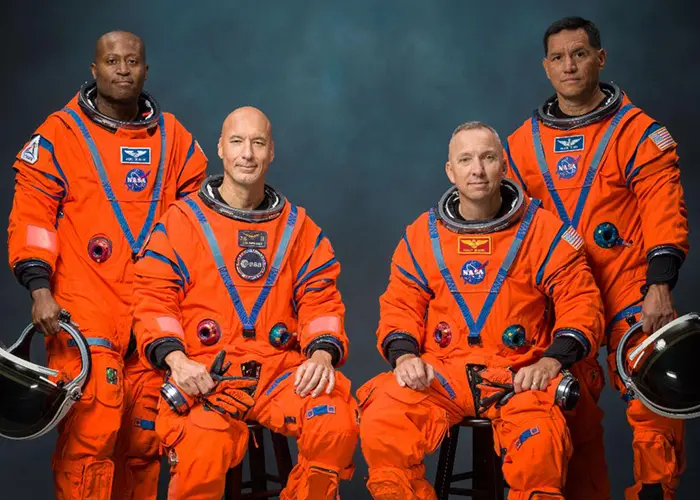
NASA has named the prime and backup crew for Artemis III, a mission the agency says is scheduled for 2027 and will focus on Earth-orbit testing intended to support the Artemis program’s next phase.
The four prime crew members are NASA astronaut Randy Bresnik (commander), ESA astronaut Luca Parmitano (pilot), and NASA astronauts Andre Douglas and Frank Rubio (mission specialists). NASA astronaut Bob Hines was named as the backup crew member.
NASA said Artemis III will launch Orion on the Space Launch System (SLS) rocket from Kennedy Space Center in Florida into low Earth orbit, where the spacecraft will conduct system checkouts and then demonstrate rendezvous and docking with test versions of commercial human landing systems being developed by Blue Origin and SpaceX.
According to the agency, the mission plan includes multiple heavy-lift launches and will test integrated hardware and software between Orion and the landers, including system interfaces, propulsion and communications. The crew is expected to spend about two days docked with a Blue Origin lander test article, followed by about a day docked with a SpaceX Starship pathfinder, before returning to Earth for a Pacific Ocean splashdown and recovery by NASA and the U.S. Navy.
In total, NASA said the crew is expected to remain in space for about two weeks, with the exact duration to be determined based on launch and docking operations.
“Today we take another bold step in humanity’s return to the Moon, building on the extraordinary foundation laid by the Artemis II astronauts,” said NASA Administrator Jared Isaacman. “Their achievements reignited global excitement for exploration, and now they pass the torch to the Artemis III team, Randy, Luca, Frank, and Andre. Artemis III will demonstrate the power of American innovation and international partnership as we test complex rendezvous and docking operations and advance the technologies that will one day carry us deeper into the solar system. This mission will require the most awe-inspiring coordination of heavy-lift rocket launches in history, drawing on the talent and capability of teams across government and the spaceflight community. The Artemis III astronauts, alongside ESA and our international partners, and the tens of thousands of the best and brightest across the agency and industry, are ushering in a new Golden Age of exploration carrying forward the hopes and dreams of the next generation just as the Apollo astronauts did for so many of us.”
NASA said the Artemis III assignment also marks the first time an ESA astronaut has been assigned to an Artemis mission.
“Artemis III will push the boundaries of spacecraft operations in orbit. Luca’s assignment as pilot reflects the depth of European expertise in human spaceflight and draws on his extensive operational experience in high-pressure situations,” said ESA director general Josef Aschbacher. “At the same time, ESA’s European Service Module will once again provide the critical capabilities that power Orion, demonstrating Europe’s enduring role at the very heart of the Artemis program. The news out of Houston today is a powerful recognition of ESA’s role in enabling humanity’s return to the Moon – and a key advancement in our partnership with NASA. Europeans can take pride in being part of this exciting journey.”
NASA said preparation work is continuing across the Orion spacecraft and the SLS rocket, including planned integration of Orion’s crew and service modules this summer and installation of the docking system, which the agency said will fly for the first time. NASA also cited ongoing heat shield testing and rocket processing work, including integration steps for the SLS core stage and plans to begin rocket stacking this summer.
Blue Origin is developing a crewed lunar version of its Blue Moon lander and SpaceX is developing a crewed lunar version of Starship, with NASA describing Artemis III as using test articles from both companies. NASA said it is supporting both lander providers through design, development, testing and evaluation.
NASA said Artemis III will build on Artemis II, which the agency said was completed in April, as it works toward future lunar missions and longer-term goals including Mars.