

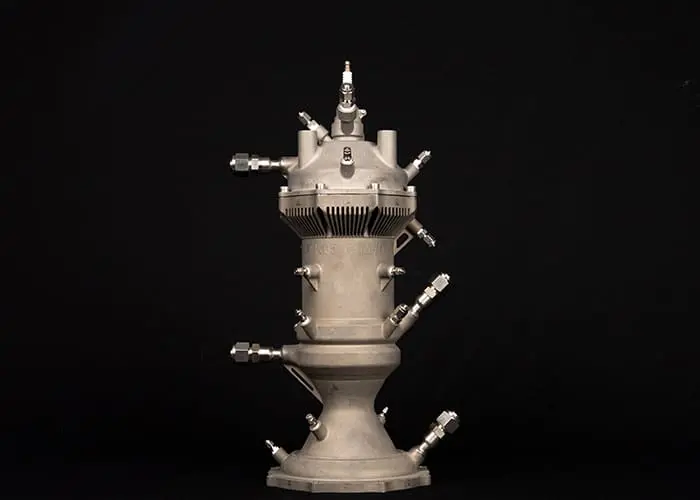
South Korean launch services company INNOSPACE says it has developed a bi-propellant regenerative cooling approach for methane engine combustors and completed a 420-second ground firing test it described as the longest domestic burn for this class of combustor.
The company said the technology is intended for its 0.4-ton (880 lbf) thrust liquid methane engine, LiMEK-04, which it plans to integrate into the kick stage of its next-generation HANBIT-Micro launch vehicle. A kick stage is designed to separate after the second-stage burn to place payloads into targeted orbits.
INNOSPACE said its approach uses both liquid methane and liquid oxygen as coolants for the combustion chamber, in contrast to conventional methane engines that typically rely on methane alone for regenerative cooling. According to the company, single-propellant cooling architectures can require higher propellant feed pressure to deliver adequate cooling performance, which can increase the mass of propellant tanks and feed systems.
INNOSPACE said the bi-propellant architecture increases coolant flow rate by about 3.0 to 3.4 times compared with conventional approaches, allowing stable cooling under lower pressure conditions and enabling lighter tanks and feed systems. The company said this could reduce overall launch vehicle mass and improve payload efficiency.
“As launch vehicles become smaller, mass efficiency becomes increasingly critical. In the small launch vehicle market, lightweight structural technologies directly affect payload capability and launch service competitiveness. With global demand for small-space propulsion systems continuing to grow, we expect this technology to have broad applicability not only in methane engines for reusable launch vehicles, but also in kick stages for small satellite orbital transfer missions and future space exploration propulsion systems,” said Soojong Kim, Founder and CEO of INNOSPACE.
The company said it previously conducted a 237-second ground firing test in May 2024 on the 0.4-ton thrust methane engine combustor for the HANBIT-Micro kick stage, and continued development incorporating liquid oxygen as a coolant.
In a separate update, INNOSPACE said that after the early termination of its first commercial launch mission, HANBIT-Nano, in December 2025, it identified the root cause, upgraded components and optimised manufacturing processes. The company said it is undergoing review with the Korea AeroSpace Administration to obtain launch authorisation and plans a follow-up launch in the third quarter of this year, subject to final approval.