

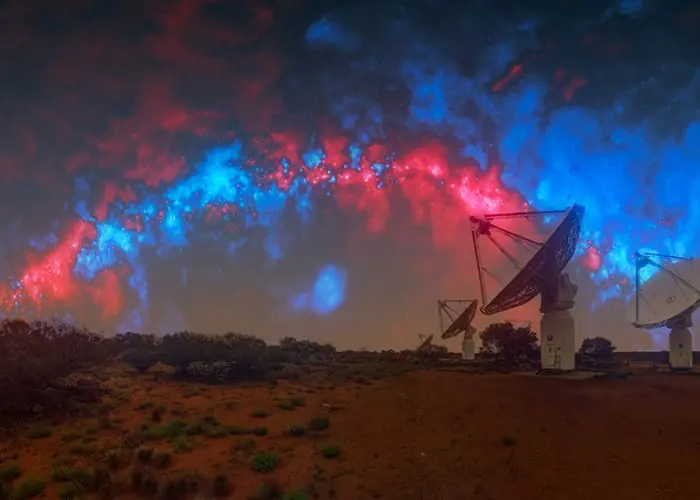
Scientists have produced what CSIRO says is the largest magnetic map of the Universe to date, a dataset intended to support new research into magnetism between galaxies and its role in how galaxies form and evolve.
CSIRO said the map is five times larger than all previous efforts combined. Magnetic fields are thought to influence how matter moves through space and how the Universe has changed over billions of years, but are difficult to observe directly.
The map was produced by an international team led by researchers at CSIRO and the SKA Observatory (SKAO), an intergovernmental organisation building large radio telescopes in Australia and South Africa. The work relied on CSIRO’s Australian Square Kilometre Array Pathfinder (ASKAP) radio telescope.
Lead researcher Dr Alec Thomson, a commissioning scientist with SKAO, said the scale and density of the map would help researchers understand how energy is distributed across the Universe. “For the first time, we can investigate fine details of the material between nearby stars, and study a huge number of distant galaxies,” he said.
CSIRO said the results have been made available to the scientific community and the associated paper has been accepted by Publications of the Astronomical Society of Australia.
ASKAP is located at Inyarrimanha Ilgari Bundara, the CSIRO Murchison Radio-astronomy Observatory on Wajarri Yamaji Country in Western Australia. CSIRO said ASKAP is a precursor to the SKA telescopes and can survey large areas of sky at once, contributing to the Rapid ASKAP Continuum Surveys (RACS).
The new map, called SPICE-RACS, uses the principle that light twists as it travels through magnetic fields. By measuring the degree of twist in light detected by ASKAP, the team inferred where magnetic fields are located and their relative strength.
“We collected rotation measures from every galaxy detected in RACS – nearly four million galaxies – and reprocessed this original data from ASKAP to retrieve the full picture,” Dr Thomson said.
Professor Naomi McClure-Griffiths, SKAO’s Chief Scientist and a member of the research team, said SPICE-RACS expands the available dataset, including coverage of the southern sky. “For the past 20 years we have been working with essentially the same data set, which didn’t even cover the southern sky. Now, we can finally answer some big questions with a much better picture of the Universe’s magnetic structures,” she said.
CSIRO astronomer Dr Tim Galvin said the map is hosted via CSIRO’s data access portal, data.csiro.au. “Our data is accessible to anyone, whether it be for something unique in their own work or to replicate something tested already – an important part of the scientific process,” he said.
CSIRO said the work is part of the Polarisation Sky Survey of the Universe’s Magnetism (POSSUM) collaboration, which plans further mapping using ASKAP in coming years. The agency said early operations of the SKA telescopes later this decade are expected to enable finer-grained mapping of the so-called cosmic web and support research into the origin of magnetic fields in the Universe.