

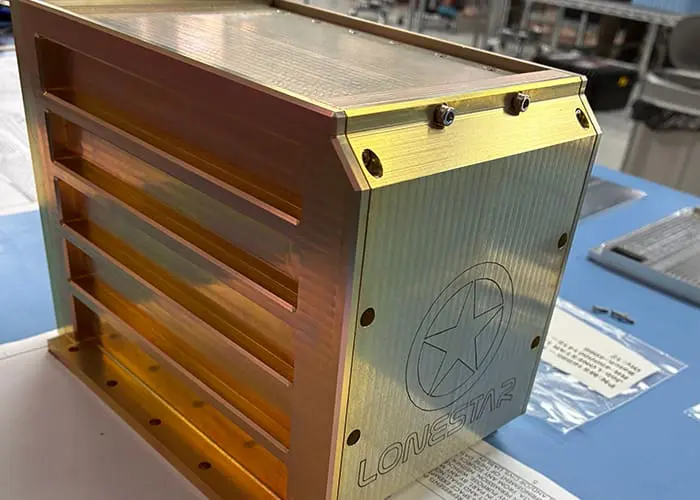
UK space-based solar power company Space Solar and US space data storage provider Lonestar have signed a letter of intent to cooperate on hosting Lonestar’s StarVault data storage modules aboard Space Solar spacecraft.
The companies said the partnership is intended to support “sovereign, secure data infrastructure in orbit”, with deployments planned across Low Earth Orbit (LEO), Medium Earth Orbit (MEO) and Geostationary Orbit (GEO).
Under the proposed arrangement, the companies outlined three work streams: joint engineering work to adapt StarVault modules for operations aboard Space Solar spacecraft; “mutual data services” under which Space Solar missions and customers could use Lonestar’s storage and processing capability; and multi-orbit deployment of StarVault modules.
The announcement links the partnership to a core constraint in orbital data-centre concepts: power availability. The companies cited a “plateau” for deployable solar arrays at around 500 kilowatts, with complexity rising above 200 kilowatts, and said Space Solar’s modular, in-space assembled structures are designed to exceed that level.
Lonestar said it plans to fly as a rideshare customer on Space Solar’s OSPREYBuilder in-space assembly demonstration mission, which is currently planned for 2028. The companies said they plan to scale to larger, higher-power hosted structures from 2030.
Sam Adlen, co-CEO of Space Solar, said: “Teaming up with Lonestar is one of those partnerships that makes immediate sense. They are pioneers in sovereign, resilient data storage in space. We are building the orbital power and platform area that lets that vision scale.”
Chris Stott, chair and founder of Lonestar, said: “At Lonestar we are building the future of resilient, sovereign data storage in space. Having already tested data storage from the lunar surface and in cislunar space, we are now scaling toward constellations of connected vaults across every orbit, and doing that at scale needs power.”
The companies said they intend to form a joint technical working group, identify pilot mission opportunities, and explore frameworks for investment, joint ventures or strategic partnerships.