
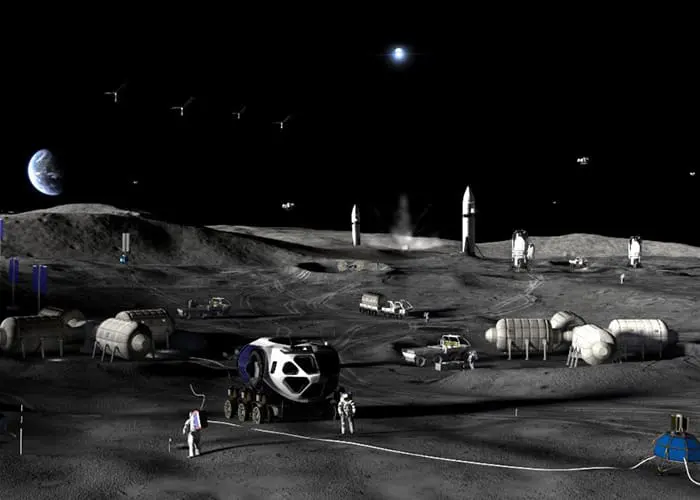
NASA says it has awarded new contracts for lunar rovers and cargo landers as it works to establish what it calls “Moon Base” infrastructure at the Moon’s south pole ahead of planned Artemis astronaut landings.
At an event at NASA Headquarters in Washington on Tuesday, the agency outlined target launch timeframes and milestones for the first infrastructure and exploration missions. NASA Administrator Jared Isaacman described the program as a step toward sustained operations on the lunar surface and said missions would be used to build experience and reduce risk.
NASA announced three initial Moon Base missions intended to begin sustained operations. Moon Base I is targeted for launch no earlier than fall 2026 and would use Blue Origin’s Blue Moon Mark 1 Endurance lander to deliver NASA payloads including instruments studying rocket plume effects on the lunar surface and a laser retroreflector array. NASA said the mission would land on the Shackleton Connecting Ridge and aims to demonstrate capabilities supporting future crewed Artemis landings in 2028.
Moon Base II is planned for launch later this year and would deliver more than 1,100 pounds of cargo on Astrobotic’s Griffin lander, including Astrolab’s FLIP rover, to help mature mobility systems for future lunar terrain vehicle operations. Moon Base III, also targeted for this year, would fly the first payload selected through NASA’s Payloads and Research Investigations on the Surface of the Moon initiative. Its anchor investigation, Lunar Vertex, is slated to fly on Intuitive Machines’ Nova-C Trinity lander to study lunar swirls, with additional payloads from the European Space Agency and the Korea Astronomy and Space Science Institute.
NASA said the missions are the first of more than a dozen it expects to announce this year, aimed at generating operational data and reducing risk ahead of crewed Artemis surface activities.
Separately, NASA said it has awarded Astrolab $219 million and Lunar Outpost $220 million under Phase 1 task orders of the Lunar Terrain Vehicle Services contract to build and deliver the first phase of Lunar Terrain Vehicles. The firm-fixed-price, performance-based contracts are intended to support the deployment of crewed and uncrewed mobility systems to the lunar surface by 2028 through NASA’s Commercial Lunar Payload Services initiative.
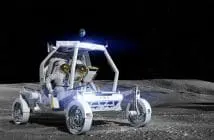
NASA said Astrolab’s proposed crewed rover, the Crewed Lunar Vehicle (CLV-1), is adapted from the company’s FLEX architecture and is designed to transport astronauts and supplies. NASA said the rover has a mass of about 2,000 pounds and can reach more than 6 mph on level terrain. NASA said Lunar Outpost’s proposed Pegasus rover is designed to meet updated requirements and is intended to operate for up to a year with manual, autonomous or teleoperated driving, at speeds above 9 mph.
To deliver the rovers to the south pole region, NASA said it awarded Blue Origin $188 million, with an option period worth $280.4 million, covering two task orders that NASA can extend based on performance. NASA said the procurement was executed under the CLPS 1.0 indefinite-delivery/indefinite-quantity framework.
NASA also provided an update on its MoonFall mission, which it said will send four drones to make short flights on the lunar surface to survey potential Artemis landing sites. NASA said the Jet Propulsion Laboratory has been developing the design and testing prototype hardware, and that Firefly Aerospace has been selected to build the spacecraft that will transport the drones from Earth orbit to the Moon. Launch is targeted for 2028.
NASA said it expects to announce additional CLPS 1.0 task awards in coming weeks, with further opportunities to compete for CLPS 1.0 and 2.0 task orders as Moon Base technology demonstrations are defined.