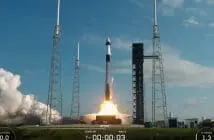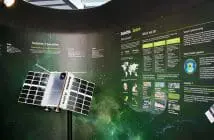

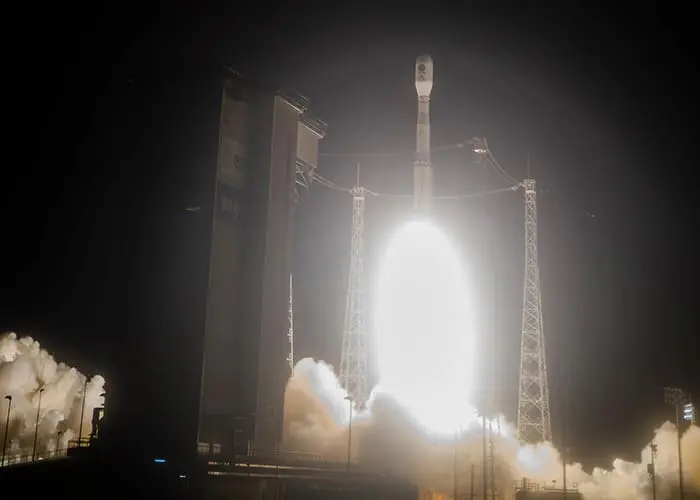
The Smile spacecraft has launched on a Vega-C rocket from Europe’s Spaceport in French Guiana, starting a joint European Space Agency (ESA) and Chinese Academy of Sciences (CAS) mission aimed at improving understanding of space weather and how Earth’s magnetic environment reacts to the solar wind.
ESA said the launch took place at 04:52 BST / 05:52 CEST (00:52 local time) on 19 May 2026. After separation, the first signal from the spacecraft was received by ESA’s New Norcia ground station in Australia at 06:48 CEST, followed by solar panel deployment at 06:49 CEST.
Smile (Solar wind Magnetosphere Ionosphere Link Explorer) is designed to study solar storms and geomagnetic storms by observing the magnetosphere and auroras using X-ray and ultraviolet instruments. ESA says the mission will produce the first X-ray observations of Earth’s magnetic shield and use ultraviolet imaging to observe auroras for up to 45 hours at a time.
“We are about to witness something we’ve never seen before – Earth’s invisible armour in action,” ESA Director General Josef Aschbacher said. He added that the mission reflects long-standing cooperation between ESA and China, and said it is intended to advance scientific knowledge and support the peaceful use of space.
ESA Smile Project Manager David Agnolon said Smile is the first mission that ESA and China have “jointly selected, designed, implemented, launched and operated” together. ESA Science Director Professor Carole Mundell said the mission builds on technologies used in previous ESA missions, including Cluster and XMM-Newton, and highlighted the collaboration between European and Chinese engineering and science teams.
ESA says Smile will compare X-ray images of the magnetosphere with ultraviolet images of auroras to track how solar wind-driven disturbances move through Earth’s magnetic environment. ESA Smile Project Scientist Philippe Escoubet said the mission’s results are expected to improve models of Earth’s magnetic environment, with potential benefits for protecting astronauts and space technologies.
Over the next month, ESA said Smile will raise its altitude via 11 engine burns into an “extremely elliptical orbit” reaching 121,000 km above the North Pole and 5,000 km above the South Pole. ESA said data collection is expected to begin in July after deployment of booms, opening camera covers, and instrument checks.
ESA said Airbus Defence and Space in Spain built the payload module carrying three of Smile’s four science instruments, including the X-ray and ultraviolet imagers, plus instrument control and communications systems. The X-ray camera, described by ESA as Smile’s largest instrument, was developed and built in the UK by the University of Leicester in collaboration with Mullard Space Science Laboratory and the Open University, alongside other European institutions.
According to ESA, contributions to the payload module and X-ray camera came from institutes and companies in 14 European countries, with the United Kingdom and Spain providing the largest contributions. ESA said its financial contribution to the mission is €130 million through more than 25 procurement contracts involving over 40 companies and institutes.