
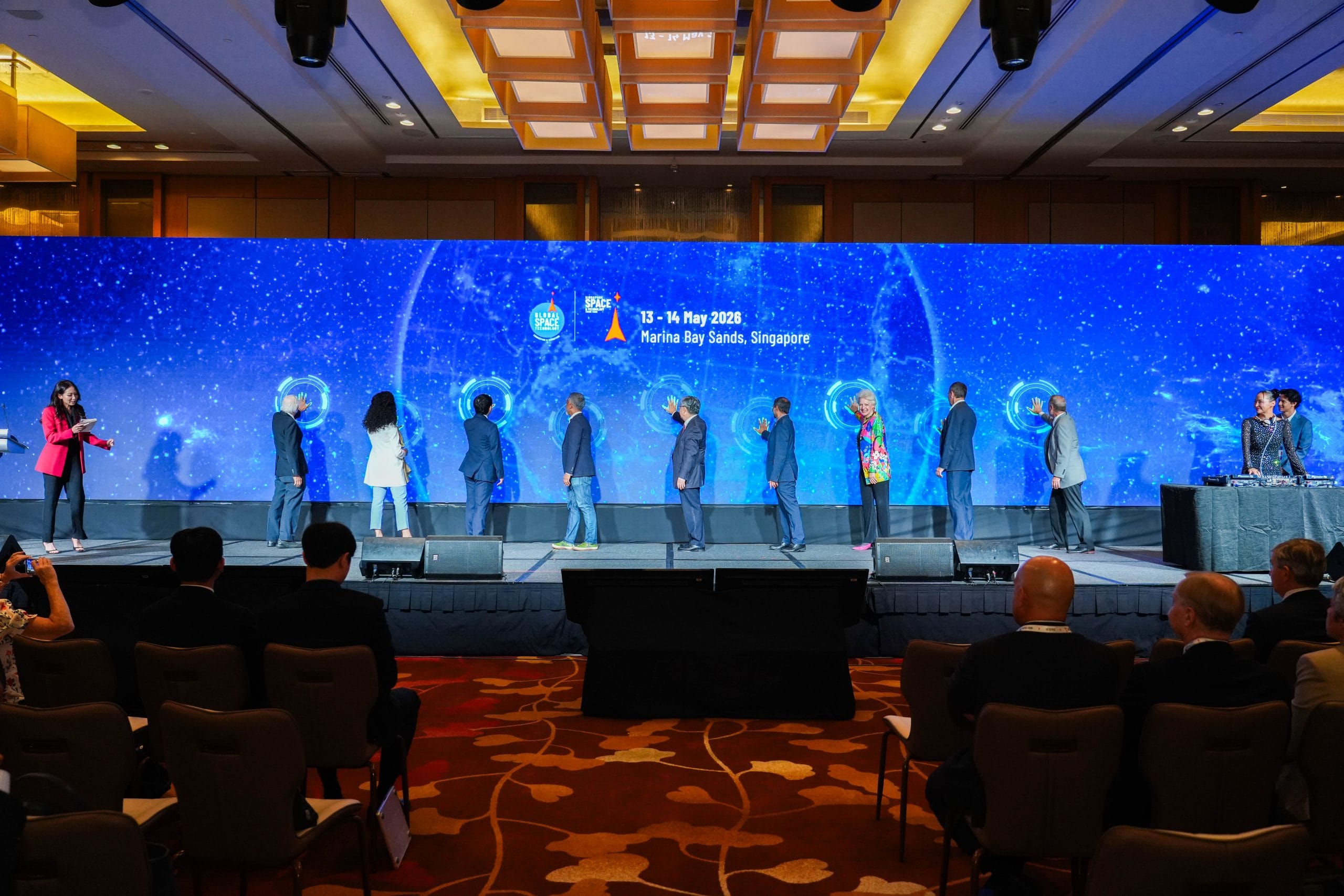
The Global Space Technology Convention & Exhibition 2026 (GSTCE 2026) opened in Singapore on 13 May, with organisers positioning the event around wider commercial adoption of space-enabled services across Southeast Asia and the Asia Pacific.
Organised by the Singapore Space & Technology Think Tank (SST Think Tank), the two-day event runs from 13 to 14 May at Marina Bay Sands under the theme “Commercialising Space: Driving Economic Value Across Industries”. The programme includes a series of partnership announcements and initiatives aimed at linking space capabilities—such as Earth observation, satellite communications, and geospatial analytics—to use cases in non-space sectors.
A report co-published by Deloitte and SST Think Tank, “Space to Thrive: Southeast Asia’s Space Industry on the Rise”, is cited as estimating that increased adoption of Earth observation data across Southeast Asia could contribute US$100 billion in additional cumulative GDP value between 2023 and 2030. The same report projects a broader cumulative value-add across Asia Pacific from increased Earth observation adoption of US$619 billion by 2030.
Deloitte and SST Think Tank also pointed to a subsequent joint report, “The Space Edge: Realising Southeast Asia’s $100bn Space Opportunity”, which they said presents success stories of space technologies being applied across the region.
“Space is becoming an operating layer for a more connected, resilient and data-driven economy. GSTCE 2026 is about making that shift practical for Asia Pacific by connecting the technology, capital, trade networks and non-space industries that can turn space capability into real economic value. Southeast Asia has the demand, the geography and the urgency. Our role is to help the region convert that opportunity into adoption, partnerships and growth,” said Jeremy Chan, Executive Chairman of SST Think Tank.
Duleesha Kulasooriya, Managing Director, Deloitte Center for the Edge Southeast Asia, said, “Together with SST Think Tank, we’ve put a number to Southeast Asia’s space opportunity to the tune of $100 billion. The next step is to show where that value is already being created and how it can scale. Earth Observation is not just a space-sector opportunity. It is a data and decision-making capability for energy, insurance, agriculture, infrastructure, public services and many other sectors. Through the Southeast Asia Pavilion and the success stories highlighted in our new report, The Space Edge, we want to help governments and businesses move from interest to use cases, business models and adoption.”
Clint Crosier to headline GSTCE 2026
GSTCE 2026 is headlined by Major General Clint Crosier, President of DeltaV Strategies, a retired US Air Force and US Space Force Major General, and founder of Amazon Web Services’ global Aerospace & Satellite business. Organisers said Crosier will speak on commercialisation trends, including how space is shifting from mission-led infrastructure to broader economic and resilience applications.
Deloitte presents first Southeast Asia Pavilion
The event includes the launch of a Southeast Asia Pavilion, presented by Deloitte. According to the organisers, the pavilion will bring together space agencies and companies from Malaysia, Thailand, Vietnam, Indonesia and the Philippines, with a focus on demonstrating regional applications and market development for space-enabled services.
SST Think Tank, BlueTide Capital and KARI partnership
GSTCE 2026 also includes a partnership announcement involving SST Think Tank, BlueTide Capital and South Korea’s Korea Aerospace Research Institute (KARI). The partnership is intended to support the international expansion of Korean space and deep tech companies into Singapore and the wider Asia-Pacific region.
According to the press release, the partnership will focus on proof-of-concept testbeds, local partnerships, commercialisation, revenue generation and investor connections. It also includes plans to support a Singapore-based accelerator programme for Korean aerospace, defence and deep tech companies.
AASTA expands with KASP participation
GSTCE 2026 will also mark the launch and expansion of the Asia Pacific Alliance of Space Trade Associations (AASTA), described as an industry-led platform connecting space trade associations across Asia Pacific and other major space markets.
The press release says the alliance is designed to support market entry through in-market business introductions, local intelligence, market familiarisation, business matching and collaboration. Founding members listed include SST Think Tank, the Space Industry Association of Australia, Cross U from Japan and Aerospace New Zealand. The release also lists ADS from the United Kingdom and KASP—the Korea Association for Space Technology Promotion—as member organisations.
Grow Asia and ESSEC initiatives
Beyond the space sector, SST Think Tank and Grow Asia—described as a multi-stakeholder partnership platform established by the World Economic Forum and ASEAN—signed a Letter of Intent to explore collaboration on using space-enabled technologies in smallholder agriculture across Southeast Asia.
The press release says the collaboration will aim to identify and scale market-focused innovations supporting climate-resilient and regenerative farming systems, including the use of satellite data, Earth observation and geospatial analytics.
GSTCE 2026 also includes the launch of an executive leadership programme by ESSEC Business School and SST Think Tank, aimed at helping business leaders in non-space sectors develop a space strategy for their organisations.
Other event highlights
Other items flagged by organisers include the launch of the Singapore Space Lab, described as a partnership between SST Think Tank and IMDA, supported by Deloitte, intended to showcase Singapore’s space ecosystem to corporates, startups, investors, government agencies and international delegations.
The event is also set to feature five country and regional pavilions: the Southeast Asia Pavilion, Singapore Pavilion, Korean Pavilion, Polish Pavilion and South African Pavilion.
“The commercialisation of space cannot happen in silos. It requires space companies, governments, investors, corporates, trade associations and non-space industries to come together around shared use cases and real commercial outcomes. GSTCE 2026 is designed to do exactly that. It is where Asia Pacific’s space opportunity becomes visible, practical and investable,” Mr Chan added.