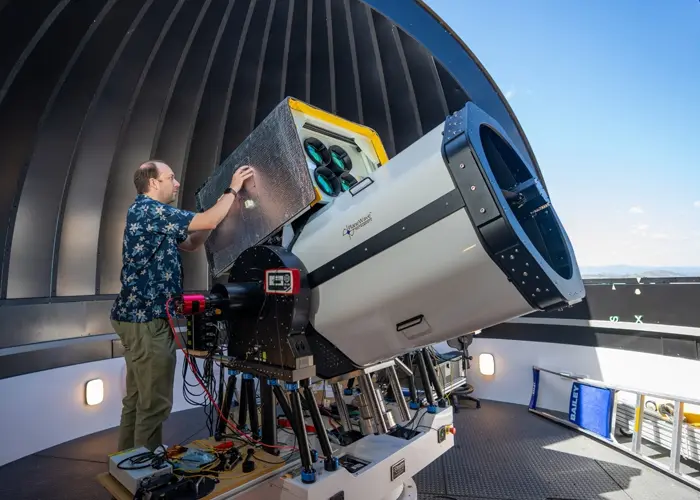
Professor Francis Bennet (pictured) with a state-of-the-art telescope at the ANU Quantum Optical Ground Station (QOGS), capable of providing space-to-ground laser communications. Photo: Nic Vevers/ANU
The Australian National University (ANU) is partnering with NASA to support a laser communications demonstration planned for the Artemis II mission, NASA’s first crewed flight beyond Earth’s orbit in more than 50 years.
NASA is scheduled to fly an optical (laser) communications system aboard the Orion spacecraft to test how the technology performs in operational conditions relevant to human spaceflight. ANU’s Quantum Optical Ground Station (QOGS) at Mount Stromlo Observatory will track Orion and transmit and receive communications during the demonstration.
ANU Professor Francis Bennet, the Australian project lead for Artemis II, said the university has been working with NASA teams “to create a capability in the Southern Hemisphere to support the agency’s future optical communication needs”.
Dr Kate Ferguson, Associate Director Strategic Projects at the ANU Institute for Space, said building optical ground station capability in the Southern Hemisphere is important for communications coverage for lunar and deeper space missions.
During the mission, ANU researchers at Mount Stromlo will work with teams from NASA’s Glenn Research Center, Goddard Space Flight Center, and the Mission Control Center at Johnson Space Center.
Space communications typically rely on radio waves, but laser communications uses infrared light to transmit data such as high-definition video, images, voice and science data. ANU said laser communications can deliver data rates up to 100 times faster than traditional radio-based systems, and noted that Artemis II would be the first crewed mission to attempt using lasers to transmit data from that distance.
NASA’s primary optical ground stations are located at the White Sands Complex in New Mexico and on Table Mountain in Southern California. ANU said that through a partnership with the Australian Space Agency (ASA), the Orion Artemis II Optical Communications System will also downlink data to the QOGS during the mission.
Enrico Palermo, Head of the ASA, said the agency had backed development of the capability at ANU.
The 10-day Artemis II test flight is scheduled for no earlier than Thursday 2 April (Canberra time), according to ANU.
ANU said the QOGS lunar communications system is supported by the ASA, which invested $4.5 million through its Moon to Mars Demonstrator Mission Grant program. The QOGS at ANU was established with funding from the ACT Government, CSIRO and the ANU Institute for Space.