
At DefSat 2026, one theme cut through the opening session discussion: space is no longer a peripheral domain — it is central to national security — and without cyber resilience, it is vulnerable.
The opening plenary speakers framed space and cyber as inseparable pillars of comprehensive national power. Over the past five years, geopolitical instability has intensified even as technology has advanced at speed. Artificial intelligence, commercial launch systems and digitised infrastructure have reshaped how nations project power and protect critical assets. In that shift, space has moved from exploration frontier to operational core.
The global space economy, valued at around US$613 billion in 2024, is projected to approach US$2 trillion within a decade. Growth is being driven by reusable rockets, proliferated satellite constellations, AI-enabled analytics and increasing private sector participation. Commercial players are now central to launch cadence, satellite manufacturing and downstream data services.
India is part of that acceleration. Missions such as Chandrayaan, Mangalyaan and Aditya-L1, alongside the forthcoming Gaganyaan human spaceflight program and participation in Artemis, signal expanding capability and strategic intent. Policy reforms, including the 2023 National Space Policy, are opening the sector to private industry at scale.
But expansion without protection carries risk.
Space-based systems underpin communications, positioning, navigation and timing, intelligence gathering, financial transactions and disaster response. Satellites enable persistent surveillance and global connectivity. In this context, data sovereignty is emerging as a pillar of power alongside energy security and nuclear deterrence.
Control of data — or denial of it — has strategic consequences. Space provides visibility and access. Cyber enables disruption, manipulation or protection. Together, they shape both economic resilience and military readiness.
Artificial intelligence is accelerating this convergence. AI enhances satellite design, processes imagery at scale and compresses decision-making timelines. However, it also introduces new attack vectors. AI can identify vulnerabilities, automate exploitation and scale cyber operations.
At the same time, major powers have formally designated space as a warfighting domain. Anti-satellite capabilities, electronic interference and cyber intrusions are no longer theoretical threats. As space assets become integral to defence operations, they become high-value targets.
Securing them is not straightforward.
Unlike terrestrial IT systems, satellites operate at extreme speeds with limited physical access once deployed. Their lifecycles can extend 10 to 15 years, complicating patching and upgrade cycles. This has elevated the concept of “orbital assurance” — protecting space infrastructure as a core element of national security.
Commercialisation further complicates the landscape. Startups and mid-sized firms are entering the space economy, expanding innovation — and the attack surface. High-resolution imagery and geospatial data are widely accessible. Digitisation is deepening integration between orbital systems and terrestrial networks, increasing interdependence.
India’s cyber ecosystem — with an estimated 65,000 professionals and hundreds of product companies — represents a strategic advantage. The challenge is aligning that capability with space security requirements and anticipating technological shifts in AI, quantum computing and advanced autonomy.
DefSat 2026 underscored a clear reality: space is not standalone supremacy, but integrative power. It connects defence, economy and digital infrastructure. It amplifies capability — and exposes vulnerability if left unsecured.
In the emerging strategic order, resilience in space and cyber will define national strength.
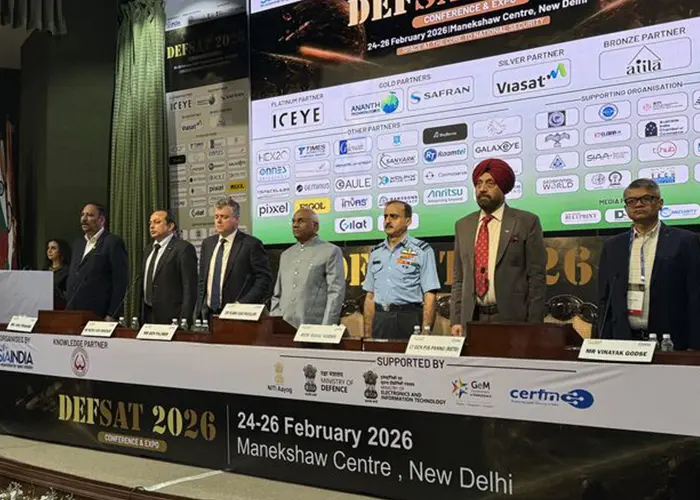
Photo: Opening Plenary, DEFSAT 2026 – Ashoka Hall, New Delhi | 24 February 2026
Defence leaders and industry executives address delegates during the DEFSAT 2026 Opening Plenary, with thematic and industry insights from Lt Gen PJS Pannu (Retd), Air Marshal Ashutosh Dixit, AVM Manu Midha, Dr Vinayak Godse, Mr Ben Palmer OBE, Mr Partha P. Roy Chowdhury, and SIA India President Dr Subba Rao Pavuluri. Credit: Space and Defence – MySecurity Media