
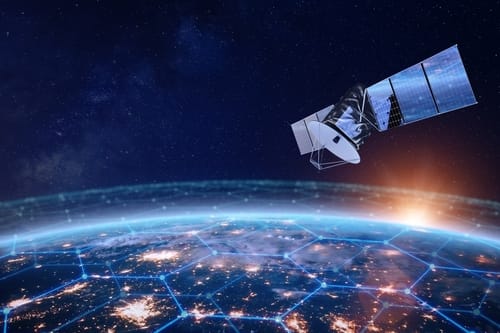
As tensions escalate in the Middle East, space technology has become an increasingly important element shaping the dynamics of the conflict involving Iran, Israel and the United States. Satellites, navigation systems and space-enabled intelligence capabilities are now deeply embedded in modern military operations, influencing how conflicts are monitored, understood and fought.
Several official statements, defence briefings and analytical reports highlight how space infrastructure and capabilities are directly affecting the current crisis.
One of the clearest acknowledgements of space’s role came from U.S. military officials, who confirmed that American forces targeted elements of Iran’s military space command infrastructure during recent operations. According to U.S. defence officials, space and cyber capabilities were among the “first movers” in the early stages of the campaign, disrupting communications and surveillance systems before conventional strikes were launched. The action was intended to limit Iran’s ability to coordinate retaliation and gather intelligence through its satellite networks.
Military analysts have also reported that Iran may be seeking external support to strengthen its space-based intelligence capabilities. The Institute for the Study of War noted that Iran could rely on satellite reconnaissance data from partners, including Russia, to improve targeting of U.S. forces and regional military infrastructure. Iran’s own satellite imagery capabilities remain relatively limited compared with those of major space powers, making access to external intelligence potentially significant.
Commercial satellite systems have also played an increasingly visible role. The widespread availability of high-resolution commercial imagery has allowed analysts, journalists and governments to monitor military developments in near real time. This proliferation of Earth-observation satellites has created what analysts describe as a “glass battlefield,” where troop movements, missile strikes and infrastructure damage can often be confirmed within hours. Some commercial satellite providers have reportedly restricted access to imagery of sensitive locations during the conflict to reduce the risk of military exploitation.
Space infrastructure itself has also become a target in the conflict. Israeli military statements indicated that strikes were carried out against facilities linked to Iran’s satellite and missile programs, including infrastructure associated with the Khayyam satellite initiative. Targeting such facilities reflects growing recognition that space-enabled intelligence systems are an integral part of military capability.
Despite these vulnerabilities, Iran has continued to develop its own space assets. The country operates a small fleet of Earth-observation satellites, including the Noor series launched by the Islamic Revolutionary Guard Corps. While these satellites provide basic reconnaissance capabilities, analysts say they remain limited compared with the advanced constellations operated by larger space powers.
Together, these developments illustrate how space has become a crucial domain alongside land, sea, air and cyberspace in modern conflict. Satellite reconnaissance, navigation systems and space-based communications networks now underpin military planning, intelligence gathering and battlefield awareness.
As the Iran conflict continues to evolve, the role of space technology is likely to expand further. Governments and defence analysts increasingly view control of space-enabled capabilities as essential to national security, highlighting how future conflicts may depend as much on access to orbit as on traditional military strength.