
Space Summit 2026 opened this week in Singapore, bringing together government leaders, space agencies, industry executives, researchers and investors amid growing calls for greater alignment across the increasingly interconnected global space ecosystem.
The two-day summit was opened by Dr Tan See Leng, Minister for Manpower and Minister-in-charge of Energy and Science & Technology at the Ministry of Trade and Industry. The event takes place as space systems play an expanding role in daily life, supporting critical functions ranging from communications and navigation to climate monitoring and national security.
As activity across orbital and downstream space domains accelerates, speakers at the summit highlighted the need for closer coordination across policy, regulation, infrastructure and commercial models to ensure the long-term resilience and sustainability of space operations.
“Space systems are integral to how societies function and economies operate,” said Leck Chet Lam, Managing Director of Experia Events. “As the space ecosystem becomes more interconnected and operationally dense, alignment across governments, industry and partners is increasingly important.” He added that the summit brings together aviation, aerospace and space stakeholders to facilitate practical discussions on shared responsibilities and future talent development.
Jonathan Hung, Executive Director of the Office for Space Technology & Industry, Singapore (OSTIn), said the summit builds on Singapore’s strengths in aerospace, precision engineering, advanced manufacturing and artificial intelligence. He noted that Space Summit 2026 positions Singapore as a convening node for global discussions on responsible development, innovation and governance in the space economy.
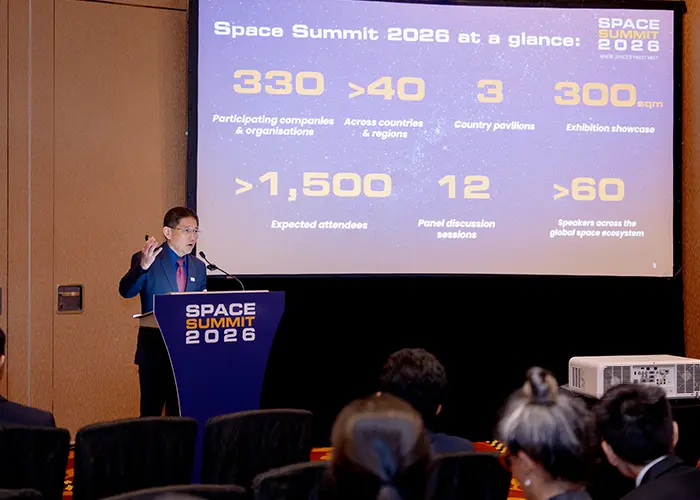
Held at the Sands Expo and Convention Centre, the summit is expected to attract more than 1,500 participants and over 300 companies and organisations, including representatives from 20 space agencies and offices. The programme features more than 60 speakers across 12 panel sessions.
Several memoranda of understanding and partnership initiatives were announced during a media briefing on the first day of the summit, reflecting increased collaboration across government, industry and research communities. Further details were released separately.
“Space Summit 2026 is a significant milestone for Singapore’s growing space ecosystem,” said Chew Hwee Yong, Chief Executive of the Association of Aerospace Industries (Singapore). He said the association is partnering OSTIn and Experia on the inaugural event, anchoring the Singapore Pavilion with 11 local space companies and formalising agreements with international counterparts to support knowledge exchange and industry development.
The summit is organised around the theme “New Frontiers: Shaping a Responsible and Inclusive Space Future”, with sessions examining issues such as satellites as national critical infrastructure, dual-use technologies, industry consolidation, launcher innovation, orbital safety and the role of Earth observation in environmental sustainability. Regional opportunities and Asia-Pacific capabilities are also a focus.
In parallel with senior-level discussions, the summit is supporting future talent development through initiatives such as the International Space Challenge, now in its 19th year, which engages students and young professionals in solving real-world space-related problems.
The summit continues on 3 February, with sessions exploring how space technologies are shaping everyday life, regional development and future economic opportunities, including resilient connectivity, maritime applications and the emerging in-space economy.