

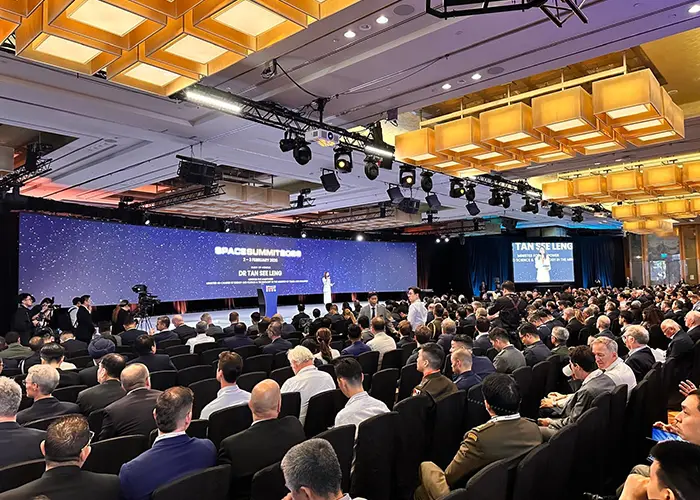
Space Summit 2026 has concluded in Singapore, closing two days of discussions focused on the growing need for alignment across an increasingly interconnected global space ecosystem.
Held at the Marina Bay Sands Expo and Convention Centre, the inaugural summit attracted more than 2,000 attendees and brought together over 300 companies and organisations. More than 60 speakers took part, including representatives from 20 national space agencies and delegations from 43 countries and regions, reflecting the expanding global reach and importance of space activity.
The summit convened senior leaders from government, space agencies, established industry players and emerging companies, creating a forum for dialogue spanning policy, commercial strategy and technology development. Sessions were structured to encourage cross-sector engagement, underscoring how space activities are now deeply linked to economic development, national resilience, sustainability and everyday life.
“Space systems are now fundamental to how economies function and societies operate,” said Leck Chet Lam, managing director of Experia Events. “Space Summit 2026 created space for open, practical conversations on how governments, industry and partners can align their approaches as space activity continues to scale and intersect with critical infrastructure, sustainability and security.”
Several common themes emerged across plenary sessions and panel discussions. One was the growing role of the Asia-Pacific region in the global space economy. Speakers highlighted a shift from experimental and demonstration projects toward operational capabilities delivering real-world services. Clear policy frameworks, scalable supply chains and strong regional and international partnerships were identified as critical to sustaining growth and attracting private investment.
Another recurring focus was the need for stronger coordination across national space programmes and stakeholders. Participants emphasised the importance of aligning national priorities and improving collaboration between governments, industry and research institutions. There was broad agreement that shared standards, interoperable systems and long-term partnership models are essential to avoid duplication, improve efficiency and support the safe and responsible use of space.
Discussions also centred on the transition from data collection to real-world impact, particularly in Earth observation. Panellists highlighted the increasing role of satellite data in environmental monitoring, climate resilience and infrastructure planning, while noting that data-sharing frameworks and collaboration are necessary to translate observations into actionable insights.
Across the two days, conversations repeatedly returned to the theme of alignment – across policy, technology and partnerships – as a prerequisite for turning space capabilities into tangible benefits for economies, societies and the environment.
Organisers said the discussions, connections and partnerships formed during the inaugural summit would carry forward into future editions. Space Summit is scheduled to return to Singapore on 25 and 26 February 2027, continuing its role as a platform for international engagement on the opportunities and responsibilities shaping the future of the global space sector.
Image Credit: MySecurity Media
Space & Defence News – Space and Earth Partners and Advisory are media partners to the Space Summit. #SpaceSummit2026