
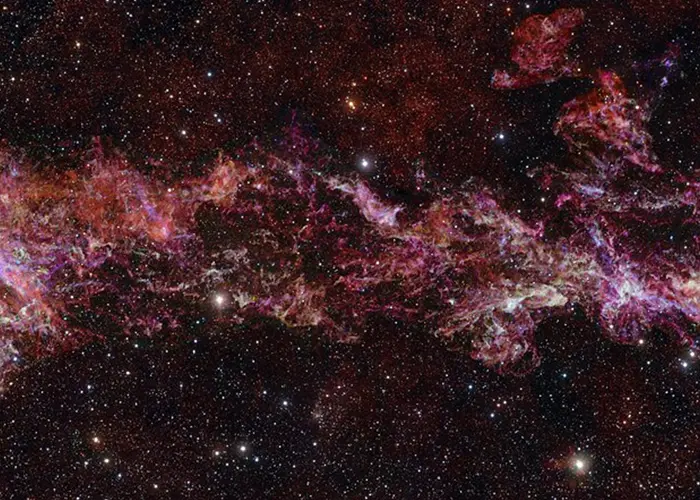
Astronomers have captured the most detailed image ever taken of the Milky Way’s centre, revealing a vast, turbulent web of cold gas filaments swirling around the supermassive black hole at the heart of our galaxy.
The record-breaking image, produced using the Atacama Large Millimeter/submillimeter Array (ALMA) in northern Chile, maps a region more than 650 light-years across. It exposes dense clouds of gas and dust normally hidden from optical view, offering an unprecedented look inside the Milky Way’s Central Molecular Zone (CMZ).
The work forms part of the ALMA CMZ Exploration Survey (ACES), an international collaboration involving more than 160 scientists from over 70 institutions, including researchers from The Australian National University (ANU).
“It’s a place of extremes, invisible to our eyes yet now revealed in extraordinary detail,” said Dr Ashley Barnes from the European Southern Observatory (ESO) in Germany.
The resulting mosaic — created by stitching together many individual observations — spans a section of sky equivalent to three full moons placed side by side. It is the largest ALMA image ever produced and the first time the telescope array has scanned such a large portion of the Galactic Centre in cold molecular gas.
That gas is critical. “The gas that ACES is targeting is cold molecular gas – the raw fuel from which stars form and that ultimately powers them,” said ANU Professor Christoph Federrath.
While astronomers have a relatively strong understanding of how stars form in the Milky Way’s outer regions, the Galactic Centre presents a far more extreme environment. The CMZ hosts some of the galaxy’s most massive stars — short-lived giants that end their lives in powerful supernovae or even hypernovae explosions.
“The CMZ hosts some of the most massive stars in our galaxy – stars that live fast and die young in spectacular explosions called supernovae, or even hypernovae,” said ACES leader Professor Steve Longmore from Liverpool John Moores University.
The new dataset reveals the region across a wide range of scales — from sprawling gas structures tens of light-years long to compact clouds surrounding individual newborn stars. This multi-scale view allows astronomers to probe how star formation operates under conditions of intense radiation, strong magnetic fields and powerful gravitational forces close to a supermassive black hole.
A defining characteristic of star-forming regions is turbulence — chaotic flows of gas and dust that compress material into dense filaments. In the Galactic Centre, that turbulence appears amplified.
“A defining feature of all star-forming clouds is their highly turbulent, chaotic flows of gas and dust,” Professor Federrath said. “Near the Galactic Centre, this turbulence becomes extreme, weaving a dense, tangled web of filaments that ultimately collapse to form new stars.”
Understanding the origin of this turbulence remains one of astrophysics’ most persistent open questions. Researchers at ANU are combining high-resolution observational data from ACES with advanced supercomputer simulations to investigate what drives such chaotic conditions and how they influence star formation efficiency.
“By combining cutting-edge supercomputer simulations with observational datasets like ACES, we can finally begin to unravel the mysteries of the extreme, chaotic conditions under which stars are born,” Professor Federrath said.
Because the Milky Way is the only galactic nucleus close enough to study in such fine detail, the findings offer a rare laboratory for testing models of star formation that also apply to distant galaxies. Insights from the CMZ could reshape understanding of how stars formed in the early universe, when galactic centres were likely more turbulent and energetic than they are today.
The ACES results are presented in a series of papers published in the Monthly Notices of the Royal Astronomical Society. The full dataset will be made publicly available through the ALMA Science Portal, enabling further research into one of the most dynamic and extreme regions of our galaxy.