
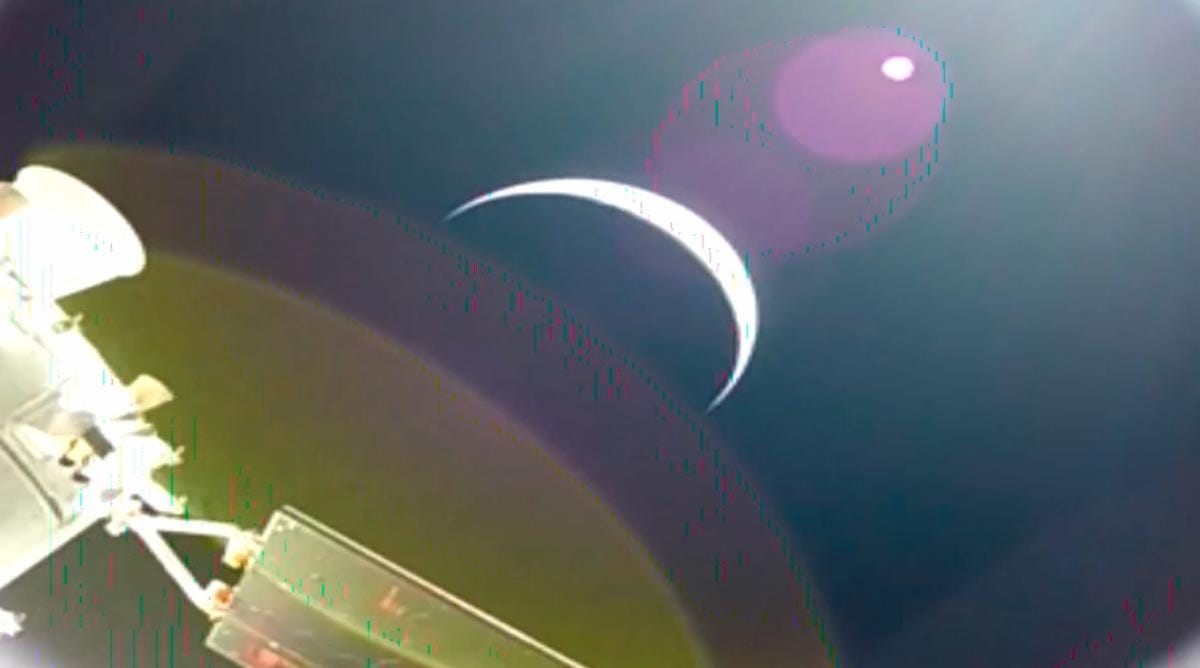
NASA says its Artemis II mission has departed Earth orbit and is now on a trajectory to fly around the Moon, following a key burn of the Orion spacecraft’s main engine.
The agency confirmed a translunar injection burn lasting about six minutes accelerated Orion and its four-person crew — NASA astronauts Reid Wiseman, Victor Glover and Christina Koch, and Canadian Space Agency astronaut Jeremy Hansen — out of Earth orbit and onto an outbound path toward the Moon.
“Today, for the first time since Apollo 17 in 1972, humans have departed Earth orbit. Reid, Victor, Christina, and Jeremy now are on a precise trajectory toward the Moon. Orion is operating with crew for the first time in space, and we are gathering critical data, and learning from each step,” said Dr. Lori Glaze, acting associate administrator for the Exploration Systems Development Mission Directorate at NASA Headquarters in Washington. “Each milestone we reach marks meaningful progress on the path forward for the Artemis program. While we have eight intensive days of work ahead, this is a big moment, and we’re proud to share it with the world.”
NASA said its Space Launch System rocket and Orion lifted off from Launch Pad 39B at Kennedy Space Center in Florida at 6:35 p.m. EDT on April 1, beginning what the agency described as a planned 10-day test flight around the Moon and back.
After reaching space, Orion deployed its four solar array wings and transitioned from launch into flight operations as flight controllers and crew began checking key systems, NASA said.
About 49 minutes into the flight, NASA said the rocket’s upper stage fired to place Orion into an elliptical Earth orbit. A second burn sent Orion — which the crew named “Integrity” — into a high Earth orbit extending about 46,000 miles above Earth for about 24 hours of system checkouts, before separating from the stage.
NASA said the crew later performed a manual piloting demonstration, using the interim cryogenic propulsion stage as a docking target, before Orion executed an automated departure burn to move away safely. The stage then performed a disposal burn and re-entered Earth’s atmosphere over a remote region of the Pacific Ocean, NASA said.
Before re-entry, four small CubeSats were deployed from the rocket’s Orion stage adapter, NASA said.
Other completed tasks included a communications transition to NASA’s Deep Space Network, crew acclimatisation, rest periods, a first flywheel exercise, returning the spacecraft’s toilet to normal operations, and configuring Orion for the translunar injection burn, according to NASA.
NASA said the mission is scheduled to conduct a lunar flyby on Monday, April 6, when the astronauts are expected to take high-resolution photographs and provide observations of the lunar surface, including parts of the Moon’s far side. NASA said the far side will be only partially illuminated during the flyby, with shadow conditions expected to improve the visibility of surface features.
Following the flyby, NASA said Orion is planned to return to Earth and splash down in the Pacific Ocean off the coast of San Diego.
More mission updates are available at https://www.nasa.gov/artemis-ii