
EdgeCortix Inc. has reported a major milestone for the use of artificial intelligence in space, announcing that its SAKURA-II AI co-processor has demonstrated high levels of radiation resilience during NASA heavy ion testing.
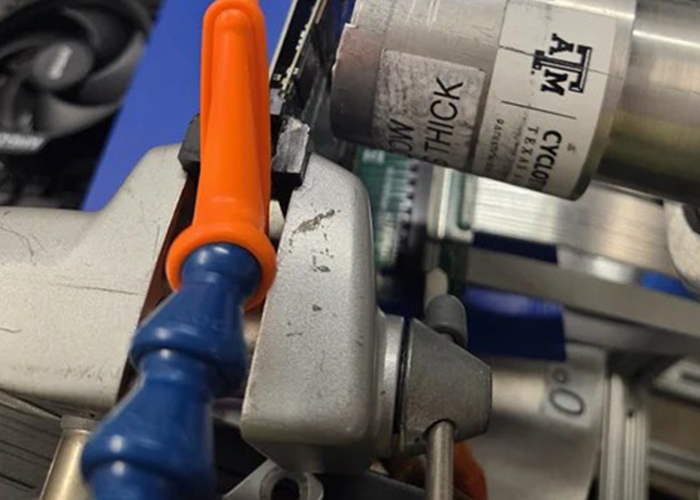
The results, documented in a report prepared by NASA’s Electronic Parts and Packaging Program (NEPP), confirm that SAKURA-II withstood harsh radiation environments without any destructive events and with relatively few transient radiation effects. Testing was conducted at the Texas A&M Cyclotron and supported by the US Defense Innovation Unit (DIU).
SAKURA-II is the second EdgeCortix AI co-processor to undergo NASA heavy ion testing. In 2024, the company reported that its first-generation SAKURA-I processor showed stronger radiation resilience than comparable AI processors. According to NASA’s latest findings, SAKURA-II delivered equivalent performance, reinforcing the company’s position in radiation-tolerant, energy-efficient AI processing.
The testing confirms SAKURA-II’s suitability for deployment in low Earth orbit, geosynchronous orbit and lunar operations. EdgeCortix said the results highlight the growing potential to enable autonomous space systems using machine learning and computer vision, particularly for applications requiring real-time, on-orbit decision-making.
EdgeCortix Founder and CEO Dr Sakyasingha Dasgupta said the completion of NASA’s heavy ion testing represents a significant step toward extending intelligent computing beyond Earth.
“These results validate SAKURA-II’s exceptional radiation resilience in the most extreme environments and demonstrate that advanced AI processing can be performed reliably directly in orbit and on the lunar surface,” he said. “As space systems increasingly demand greater autonomy, lower power consumption and real-time decision-making, EdgeCortix is proud to help enable a new generation of energy-efficient, AI-driven space exploration.”
The NEPP testing initiative is focused on advancing autonomy in space systems. While machine learning and computer vision have significantly improved sensor processing capabilities, their computational demands often exceed the limits of embedded CPUs. GPUs, while powerful, typically consume too much power for many space missions. EdgeCortix’s architecture is designed to bridge this gap by delivering high-performance AI processing at significantly lower power levels.
NASA’s full report, titled EdgeCortix SAKURA-II Machine-Learning Accelerator SEE Heavy Ion Test Report, is publicly available via the NASA Technical Reports Server.