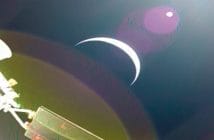
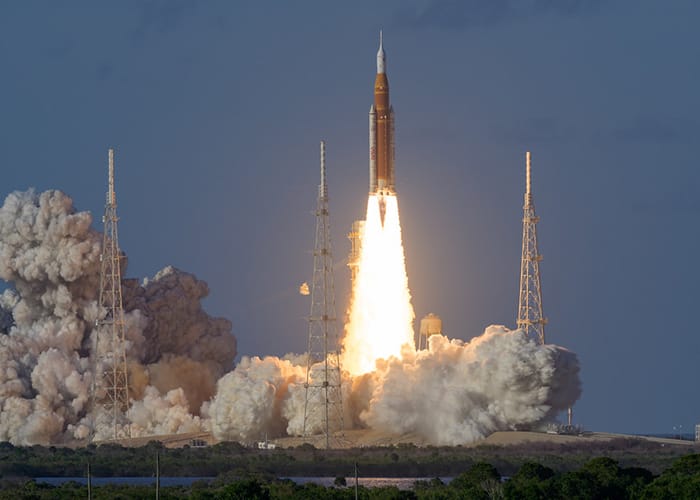
NASA has launched the crewed Artemis II mission, sending four astronauts aboard the Orion spacecraft on a planned test flight around the Moon and back.
The agency’s Space Launch System (SLS) rocket lifted off from Launch Pad 39B at Kennedy Space Center in Florida at 6:35 p.m. EDT on Wednesday, April 1 (9:35am AEDT, Thursday April 2).
The approximately 10-day mission carries NASA astronauts Reid Wiseman, Victor Glover and Christina Koch, and Canadian Space Agency astronaut Jeremy Hansen. NASA said the flight is intended to demonstrate life support systems with crew for the first time and to further validate Orion and SLS ahead of later Artemis missions.
“Today’s launch marks a defining moment for our nation and for all who believe in exploration,” NASA Administrator Jared Isaacman said in a statement. “Artemis II is the start of something bigger than any one mission.”
After reaching space, Orion deployed its solar array wings and NASA said flight teams began transitioning the spacecraft from launch to flight operations to check key systems.
“Artemis II is a test flight, and the test has just begun,” NASA Associate Administrator Amit Kshatriya said. “Over the next 10 days, Reid, Victor, Christina, and Jeremy will put Orion through its paces so the crews who follow them can go to the Moon’s surface with confidence.”
NASA said about 49 minutes into the flight, the SLS upper stage fired to place Orion into an elliptical Earth orbit, with a second planned burn expected to propel the spacecraft into a high Earth orbit extending about 46,000 miles beyond Earth. Orion, which NASA said the crew named “Integrity,” is expected to separate from the upper stage after the burn.
NASA said the upper stage is also expected to deploy four CubeSats—small satellites from Argentina’s Comisión Nacional de Actividades Espaciales, Germany Space Agency, Korea AeroSpace Administration, and Saudi Space Agency—for scientific investigations and technology demonstrations.
The mission plan includes a manual piloting demonstration in high Earth orbit, followed—if systems remain healthy—by a translunar injection burn on Thursday, April 2, using Orion’s European-built service module, NASA said.
NASA said the mission will include a multi-hour lunar flyby on Monday, April 6, during which the crew is expected to take photographs and provide observations of the lunar surface, including some areas of the far side. Following the flyby, the spacecraft is expected to return to Earth and splash down in the Pacific Ocean.