NASA and the U.S. Department of Energy (DOE) have renewed their long-standing partnership to advance the development of a nuclear fission surface power system for use on the Moon, supporting the Artemis campaign and future missions to Mars.
The renewed collaboration was formalised through a newly signed memorandum of understanding, which commits the two agencies to jointly developing, fuelling, authorising and preparing a lunar surface nuclear reactor for deployment. The effort is aimed at enabling sustained human and robotic operations on the Moon later this decade, with a target of deploying a lunar surface reactor by 2030.
NASA said fission surface power will provide a critical capability for long-duration missions by delivering continuous, reliable electrical power independent of sunlight, lunar night cycles or extreme temperature conditions. Unlike solar-based systems, a nuclear reactor could operate for years without refuelling, supporting habitats, science payloads, resource utilisation systems and surface mobility.
NASA Administrator Jared Isaacman said achieving long-term human presence on the Moon and future missions to Mars will require new approaches to power generation. He said closer collaboration with the Department of Energy is essential to delivering the capabilities needed to support sustained exploration and infrastructure development beyond Earth orbit.
The fission surface power system is expected to produce safe, efficient and scalable electrical power, forming a foundational element of NASA’s Moon-to-Mars architecture. Continuous power availability is seen as a key enabler for permanent lunar bases, in-situ resource utilisation and expanded scientific operations in permanently shadowed regions.
U.S. Secretary of Energy Chris Wright said the partnership builds on decades of collaboration between the two agencies, combining expertise in nuclear engineering, space systems and national security. He said the program continues a legacy of large-scale scientific and engineering achievements that have historically underpinned major advances in both space exploration and nuclear technology.
NASA and DOE have worked together for more than 50 years on space-related nuclear systems, including radioisotope power sources and propulsion technologies. The renewed agreement extends that cooperation to surface-based nuclear reactors, which are increasingly viewed as essential infrastructure for deep-space exploration.
The fission surface power initiative is expected to involve close collaboration with U.S. industry as NASA moves toward demonstration missions and eventual operational deployment on the lunar surface.
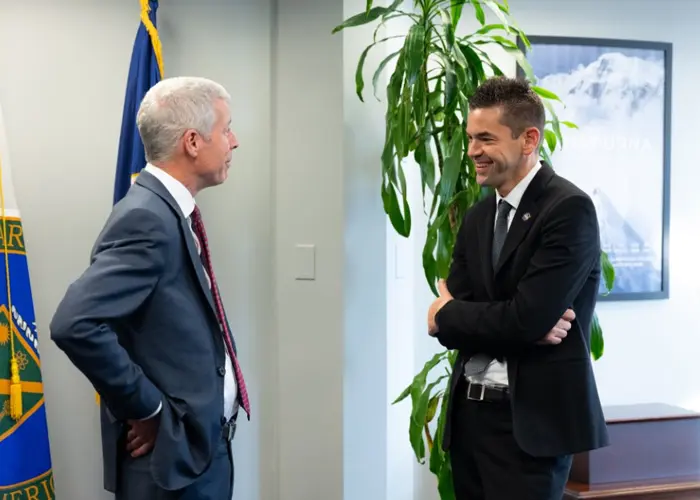
Photo: U.S. Secretary of Energy Chris Wright (left) and NASA Administrator Jared Isaacman (right) meet at the Department of Energy headquarters in Washington on Jan. 8, 2026.
Credit: NASA/John Kraus