
NASA has outlined plans to accelerate its Artemis program, adding an additional mission in 2027 and committing to at least one lunar surface landing per year from 2028, as the agency seeks to increase launch cadence and standardise hardware configurations amid intensifying geopolitical competition.
The announcement, made at Kennedy Space Center, signals a shift toward a more phased and repeatable approach to deep space operations. Artemis III, now scheduled for 2027, will no longer be positioned as the first crewed lunar landing of the program. Instead, it will focus on systems validation in low Earth orbit ahead of an Artemis IV landing mission targeted for 2028.
Under the revised plan, Artemis III will test operational capabilities including rendezvous and docking with one or both commercial lunar landers being developed by SpaceX and Blue Origin. NASA says the mission will include in-space testing of docked vehicles, integrated checks of life support, communications and propulsion systems, and evaluation of the next-generation Extravehicular Activity (xEVA) suits. Detailed mission objectives are still being defined in consultation with industry partners.
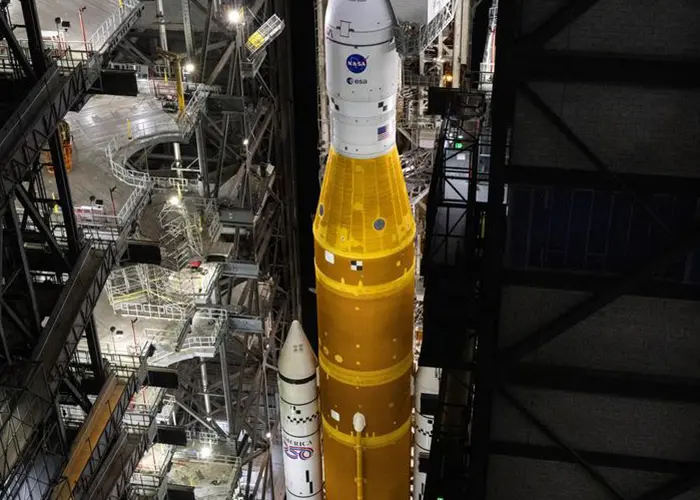
The restructuring comes as Artemis II — the first crewed flight of NASA’s Space Launch System (SLS) and Orion spacecraft — moves closer to launch. The stack was rolled back to the Vehicle Assembly Building on 25 February for repairs following the discovery of a helium issue on the Interim Cryogenic Propulsion Stage. Teams are also replacing batteries in the flight termination system and conducting end-to-end range safety tests ahead of potential April launch opportunities.
NASA Administrator Jared Isaacman framed the changes as both operational and strategic.
“NASA must standardize its approach, increase flight rate safely, and execute on the President’s national space policy,” he said, citing “credible competition from our greatest geopolitical adversary” as a driver for faster execution.
The emphasis on standardisation reflects internal concerns about development risk and production complexity. NASA Associate Administrator Amit Kshatriya said altering the configuration of the SLS and Orion stack for subsequent missions would introduce unnecessary risk at a stage where the agency is still building operational experience.
Instead, NASA intends to maintain the SLS in a configuration close to its current “Block 1” design for landing missions, rather than transitioning immediately to more evolved variants. The approach mirrors lessons drawn from Apollo, where incremental capability development and configuration stability were central to mission reliability.
The agency also linked the accelerated cadence to a recently announced workforce directive aimed at rebuilding in-house engineering capability. NASA says expanding civil servant involvement alongside commercial partners will support safer and more reliable operations as flight frequency increases.
Industry partners signalled readiness to support the revised timeline. Boeing, prime contractor for the SLS core stage, said its production workforce and supply chain were prepared for increased demand. The SLS remains the only US rocket currently certified to send astronauts directly to lunar orbit in a single launch, although its cost profile and production rate have drawn scrutiny from lawmakers and analysts.
The commitment to annual lunar landings from 2028 onward represents an ambitious shift for a program that has faced schedule pressure and budget constraints since its inception. Artemis I, an uncrewed test flight, launched in late 2022 after multiple delays. Artemis II will mark the first crewed mission of the architecture, but its timeline has already slipped from earlier projections.
The revised mission sequencing also highlights NASA’s increasing reliance on commercial lunar lander providers. SpaceX’s Starship-based Human Landing System and Blue Origin’s Blue Moon lander are both under development, with technical milestones still ahead before operational readiness is demonstrated.
If achieved, a steady annual cadence of lunar surface missions would mark the most sustained period of human exploration beyond low Earth orbit since the Apollo era. Whether NASA can meet that tempo will depend on hardware readiness, funding stability and the successful integration of multiple commercial systems into a unified lunar architecture.
For now, Artemis remains both a technical undertaking and a strategic signal — aimed at demonstrating US leadership in deep space exploration at a time when international competition in cislunar space is accelerating.
Photo: NASA’s crawler-transporter 2, carrying the agency’s Artemis II SLS (Space Launch System) rocket with the Orion spacecraft, arrives Feb. 25, 2026, inside the Vehicle Assembly Building at NASA’s Kennedy Space Center in Florida to troubleshoot the flow of helium to the rocket’s upper stage, the interim cryogenic propulsion stage. Once complete, the SLS rocket will roll back to Launch Complex 39B to prepare to launch four astronauts around the Moon and back for the Artemis II test flight.
Credit: NASA/Cory Huston