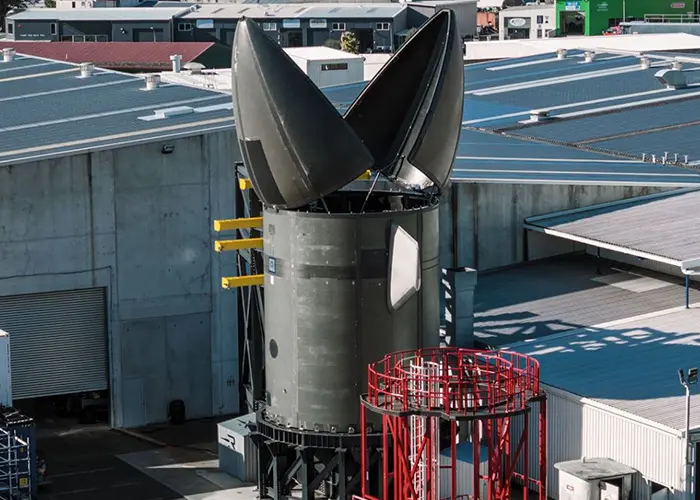
Rocket Lab has completed qualification testing of the “Hungry Hippo,” the fairing structure developed for its Neutron launch vehicle, marking a major step toward the rocket’s planned first flight in 2026. The fairing has now been shipped to Launch Complex 3 at the Mid-Atlantic Regional Spaceport in Virginia, where it will be integrated with Neutron’s first stage for further testing.
Hungry Hippo is a 5.5-metre-diameter composite fairing designed to remain attached to the rocket’s first stage throughout launch, re-entry and landing. The approach differs from conventional orbital launch systems, where fairings are jettisoned shortly after ascent. Rocket Lab says the design supports Neutron’s targeted reusability model, which relies on the first stage returning to Earth intact.
Qualification involved structural and operational tests to simulate the aerodynamic and mechanical loads encountered during launch and recovery. According to the company, the test campaign included applying approximately 275,000 pounds of force across the fairing structure to replicate conditions at Max Q, the point of maximum aerodynamic pressure. The system’s opening and closing mechanism was also verified under flight-like conditions, completing its cycle in around 1.5 seconds.
Additional evaluations combined flight software, avionics, guidance and control systems, and canard actuation to assess the fairing’s integration with Neutron’s broader architecture. Combined torque and bending loads at the canard hubs were tested to more than 125 percent of expected flight loads to validate performance margins.
Neutron, under development since 2021, is a medium-lift launch vehicle built primarily from carbon composites and is designed to carry up to 13,000 kilograms to low Earth orbit. If the program continues on schedule, the rocket is expected to join the growing field of partially reusable commercial launch systems competing for medium-class payloads.
With Hungry Hippo now at the Virginia launch site, the next phase will involve integration with the first stage and a series of pre-launch tests, including static fires and a wet dress rehearsal, ahead of Neutron’s inaugural flight.