
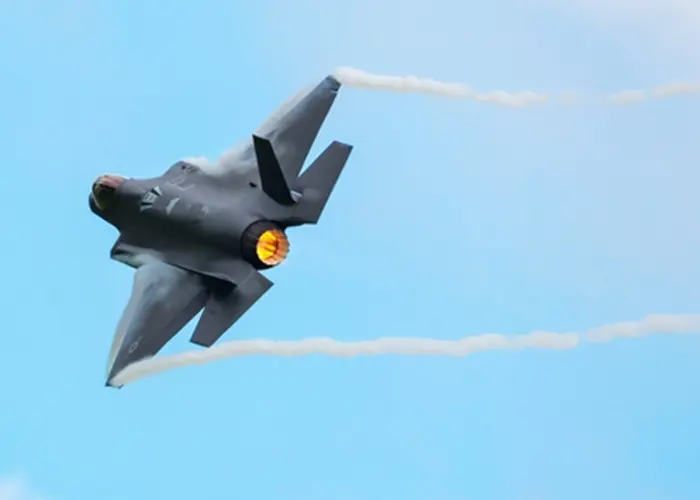
Lockheed Martin has flight tested an artificial intelligence-enabled Combat Identification (Combat ID) capability integrated into the F-35’s information fusion system, marking what the company says is the first time a tactical AI model has generated an independent combat identification directly on a pilot’s display during flight.
The demonstration, known as Project Overwatch, took place at Nellis Air Force Base in Nevada. During the test, a Lockheed Martin-developed machine learning model processed sensor data in-flight to resolve identification ambiguities among electronic emitters. The aim was to improve situational awareness and reduce the time required for pilots to interpret complex threat information in contested environments.
According to the company, engineers were able to label newly detected emitters, retrain the AI model to recognise a new emitter class within minutes, and reload the updated model for the next sortie within the same mission planning cycle. That rapid retraining loop is being positioned as a key step toward more adaptive combat systems capable of responding to evolving threat libraries.
The F-35’s core advantage lies in its sensor fusion architecture, which aggregates data from onboard and offboard sources into a single operational picture. By embedding AI into that architecture, Lockheed Martin is seeking to automate parts of the identification process that would otherwise require manual interpretation or post-mission updates.
In operational terms, faster and more accurate combat identification can reduce pilot cognitive load, particularly in environments saturated with electronic warfare signals, unmanned systems and long-range missile threats. Modern air combat increasingly hinges not just on platform performance, but on decision speed and information dominance.
The announcement also aligns with a broader shift across US defence programs toward software-defined capability and iterative upgrades. Lockheed Martin cited recent examples of deploying real-time, over-the-air software updates to the Aegis combat system aboard US Navy ships in the Red Sea to counter advanced drone and missile threats. That model of continuous software modernisation is increasingly being applied to air platforms as well.
While company executives described the test as “6th Gen technology brought to a 5th Gen platform,” the longer-term significance lies in how AI models are trained, validated and certified for operational use. Integrating machine learning into safety-critical and mission-critical systems raises questions around testing rigor, explainability, cybersecurity resilience and rules of engagement — particularly when AI contributes to threat identification.
Lockheed Martin says the Project Overwatch results will inform future development and potential integration pathways. The F-35 program, now operated by 12 nations with more than 1,300 aircraft delivered globally, represents a substantial installed base for incremental capability upgrades.