Astroscale has been granted a new U.S. patent that advances methods for capturing and servicing tumbling satellites, addressing one of the longstanding technical challenges in on-orbit servicing and space sustainability.
The patent, titled Method and Device for Capture of Tumbling Space Objects (U.S. Patent No. 12,479,603 B2), outlines a spacecraft design and control approach that enables a servicing vehicle to safely synchronize with an uncontrolled, rotating satellite before physical capture. Tumbling satellites are particularly difficult to service, as uncontrolled rotation increases the risk of collision, shock loading or fragmentation during contact, potentially adding to the orbital debris environment.
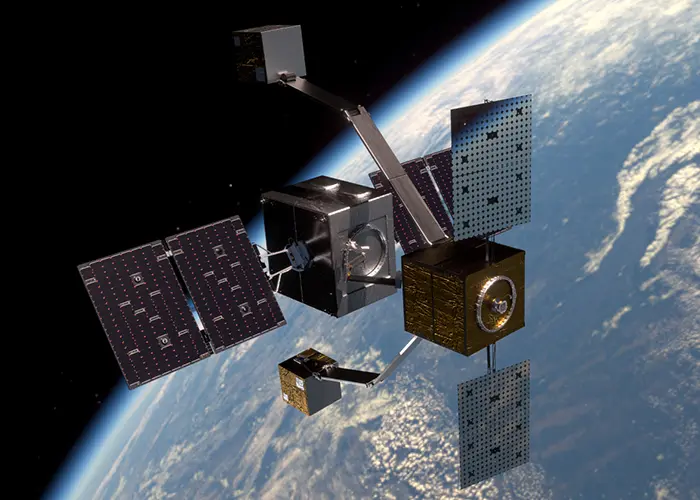
The patented method introduces a servicer architecture that incorporates an internal clearance volume and a mechanism for shifting the spacecraft’s centre of mass using counter-masses. By aligning its centre of gravity with that of the client satellite, the servicer can match the client’s rotation rate without firing thrusters or expending propellant. This allows the two objects to effectively “co-orbit” in a synchronized state prior to mechanical attachment.
Once rotational alignment is achieved, the servicer can establish physical contact at near-zero relative rotation, enabling docking or capture using tools such as robotic arms. This reduces both fuel consumption and the risks associated with repeated thruster firings near the client spacecraft. After stabilization, the satellite becomes accessible for activities such as inspection, refuelling, repair, relocation or controlled deorbiting.
The approach also enables greater flexibility once capture has been achieved. Unlike conventional servicing concepts that rely on a fixed docking point and the reach of a single robotic arm, the patented design allows the servicer to reposition itself around the client without propulsion. This capability would enable access to multiple sides of a spacecraft, expanding the range of possible servicing tasks and supporting more complex operations such as in-orbit upgrades or modular assembly.
According to Astroscale Chief Technology Officer Mike Lindsay, the method addresses several operational constraints that have traditionally limited servicing missions, including fuel usage, proximity operations and clearance management around rotating objects.
The patent has broader implications beyond satellite life extension. By enabling safer handling of uncontrolled objects and modular components, the technique supports future concepts for in-orbit assembly and large-scale orbital infrastructure, where components may not be fully stabilized at the time of integration.
The new patent adds to a growing body of intellectual property focused on on-orbit servicing and debris mitigation. Astroscale previously disclosed work on multi-object debris removal architectures designed to enable scalable and controlled reentry operations.
Together, these developments point toward a future in which satellites are designed with servicing and end-of-life management in mind, reducing waste in orbit and supporting more sustainable use of the space environment.