
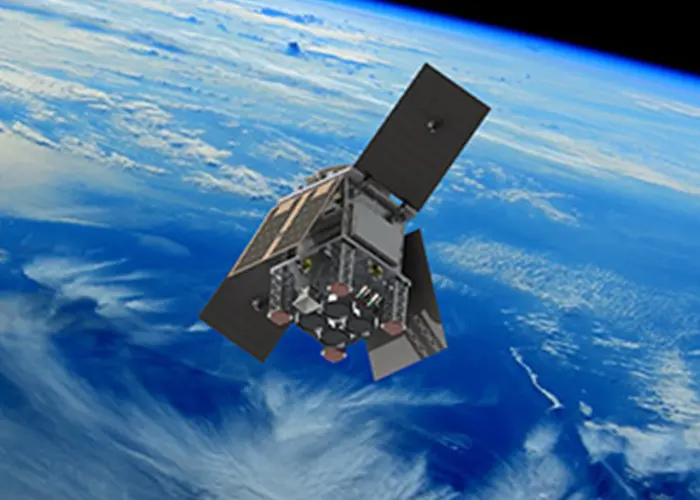
ESA’s HydroGNSS mission has launched, marking a major step forward in global monitoring of water availability and the impacts of climate change on Earth’s water cycle. The two twin satellites, the first of the agency’s new low-cost Scout missions, lifted off on 29 November at 05:44 AEDT aboard a SpaceX Falcon 9 rocket as part of the Transporter-15 rideshare flight from Vandenberg Space Force Base in California.
Less than 90 minutes after launch, the satellites separated from the rocket, and at 08:45 AEDT Surrey Satellite Technology Ltd (SSTL) in the UK confirmed receipt of signals, verifying that both spacecraft were safely in orbit. Designed to “scout for water”, the satellites use a technique known as GNSS reflectometry, receiving L-band microwave signals from navigation systems such as GPS and Galileo and analysing the way those signals change when reflected from Earth’s surface.
Each HydroGNSS spacecraft carries a delay Doppler mapping receiver with two antennas: a zenith antenna to track direct GNSS signals and a nadir antenna to capture the reflected ones. By comparing direct and reflected signals, the mission will gather data on soil moisture, freeze–thaw conditions, inundation, and above-ground biomass. The twin satellites will orbit Earth 180 degrees apart, providing wide coverage and increasing data frequency.
The resulting measurements will support improved understanding of Earth’s water cycle, including contributions to flood prediction, agricultural planning, and mapping wetland extent — critical for identifying methane-producing ecosystems often hidden beneath forest canopies. Freeze–thaw observations will inform knowledge of surface radiation balance, energy and carbon exchanges, and permafrost behaviour in high-latitude regions. Biomass data will support estimates of forest carbon stocks and their role in the global carbon cycle.
HydroGNSS is the first mission to reach orbit under ESA’s Scout programme, which follows a fast-paced, New Space-inspired approach that delivers small, agile missions from concept to launch in only three years on a lean €35 million budget covering design, construction and operations. ESA’s Director of Earth Observation Programmes, Simonetta Cheli, said the launch represents an important milestone for both the Scout missions and ESA’s broader FutureEO programme, which blends rapid-deployment missions with the agency’s larger flagship Earth Explorer missions.
SSTL is ESA’s prime contractor for HydroGNSS and is responsible for satellite operations and data distribution. The mission also benefits from partial funding from the UK Space Agency.
The Transporter-15 launch also carried other national missions developed with ESA involvement. Italy’s IRIDE constellation received its next batch of Eaglet-II satellites. IRIDE, led by the Italian government and coordinated by ESA with support from the Italian Space Agency, is a major Earth observation initiative providing data for monitoring ground motion, land cover, water resources, coastal zones and other environmental factors, supporting national authorities and Italy’s Civil Protection Department.
Greece launched its first pair of high-resolution ICEYE radar satellites under the Greek National Small Satellite Programme. The programme will expand next year with additional satellite types and aims to strengthen Greece’s space technology capabilities, create jobs, support environmental and disaster monitoring, and enhance national security applications. It is led by the Hellenic Space Center and the Ministry of Digital Governance, with ESA offering programme support and assisting ICEYE in satellite development.
Both the Italian and Greek missions were funded through the EU Recovery and Resilience Facility.
Image: Artist render of HydroGNSS satellite – Credit: ESA