
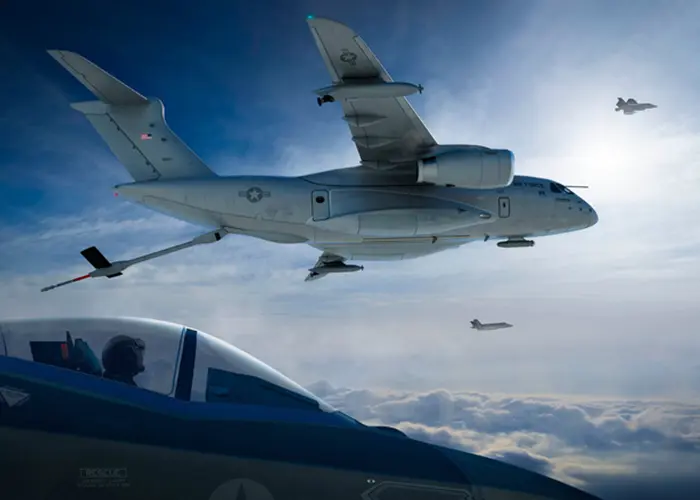
Embraer and Northrop Grumman have announced a joint effort to further develop the KC-390 Millennium as an advanced multi-mission tanker aircraft, targeting potential future requirements of the United States Air Force and allied nations.
The collaboration centres on evolving the Brazilian-built KC-390 platform with enhanced air-refuelling capabilities, including the development of an autonomous aerial refuelling boom. The companies say the initiative is backed by joint investment and is aimed at addressing emerging requirements for agile combat employment and distributed operations.
While the KC-390 is already operational as a transport and tanker aircraft with several air forces, the proposed enhancements would expand its role, particularly in boom-based refuelling — the system used by the US Air Force for many of its fixed-wing aircraft. At present, the KC-390 primarily uses hose-and-drogue refuelling systems, which are compatible with many allied aircraft but not all USAF platforms.
According to the companies, the upgraded variant would incorporate advanced communications, improved situational awareness tools, survivability options and adaptable mission systems. The goal is to broaden the range of aircraft that can be supported during refuelling operations and to integrate the aircraft more deeply into future aerial logistics architectures.
The announcement comes at a time when the US Air Force continues to modernise its tanker fleet. The Boeing KC-46A Pegasus is currently being introduced to replace legacy KC-135 aircraft, though the program has faced technical and schedule challenges over the past decade. It remains unclear whether the Embraer–Northrop initiative is intended to compete directly for future US tanker procurements, complement existing platforms, or target allied export markets primarily.
Northrop Grumman’s role appears focused on systems integration, mission architecture and advanced technologies, leveraging its experience in aeronautics systems and defence electronics. Embraer brings the underlying KC-390 airframe, which has been marketed as a cost-effective, jet-powered alternative to traditional turboprop tactical airlifters in the medium transport category.
The companies have not disclosed development timelines, funding levels, or whether discussions with the US Department of Defense have progressed beyond exploratory engagement. No formal procurement program has been announced by the USAF tied specifically to a KC-390 boom-equipped variant.
The KC-390 has been selected by several countries, including Brazil and a number of European operators, as a multi-mission airlifter capable of troop transport, cargo operations, medical evacuation and aerial refuelling. Embraer positions the aircraft as a 21st-century platform designed with digital avionics and modern performance characteristics.
For Embraer, deeper penetration into the US defence market would represent a significant strategic milestone. For Northrop Grumman, the partnership offers a way to participate in potential tanker or air mobility competitions without developing an entirely new airframe.
Whether the joint effort translates into a formal acquisition pathway will depend on US and allied force structure decisions, budget priorities and the competitive landscape. For now, the announcement signals an intent to position the KC-390 as a more versatile tanker option in an increasingly contested and capability-driven global air mobility market.
Photo: KC-390 Millennium