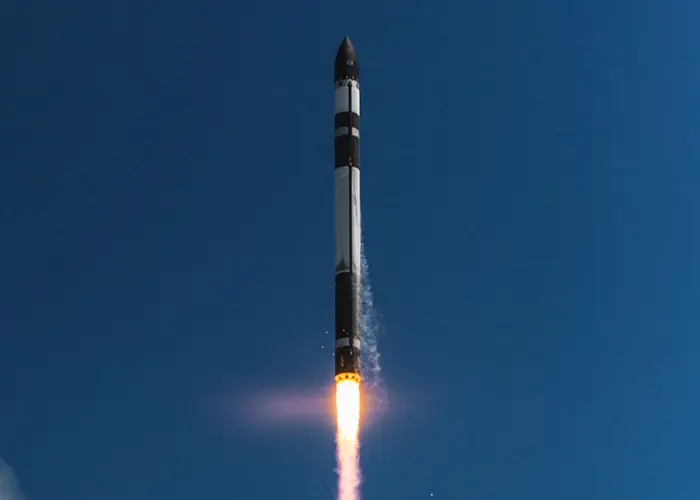
Rocket Lab has completed its 81st Electron launch, placing a single Earth observation satellite into orbit for the Korea Advanced Institute of Science and Technology, marking another step in the growing role of small launch providers in supporting national research and space capability.
The mission, named “Bridging The Swarm”, lifted off from Rocket Lab Launch Complex 1 in New Zealand at 2:21pm NZDT (12:21 pm AEDT) on 30 January. The Electron rocket successfully deployed NEONSAT-1A, a satellite developed by KAIST and equipped with a high-resolution optical imaging payload for Earth observation.
KAIST is regarded as South Korea’s leading university focused on science and technology, and the mission highlights the expanding participation of academic institutions in space-based sensing and data collection. University-led satellite programs are increasingly being used to develop sovereign expertise in spacecraft design, imaging systems and data analysis, while also contributing to national and regional space strategies.
For Rocket Lab, the launch underscores the operational cadence it is building around its Electron small launch vehicle. The KAIST mission was the second Electron launch to be conducted within eight days from Launch Complex 1 and the company’s second launch of the year, pointing to a maturing launch infrastructure capable of supporting responsive and repeatable access to orbit.
Small satellite missions such as NEONSAT-1A reflect broader trends in the space sector, where Earth observation capabilities are being distributed across larger constellations of smaller spacecraft. High-resolution optical imaging remains in strong demand across environmental monitoring, urban planning, disaster response and security-related applications, particularly in the Asia-Pacific region.
As launch frequency increases and costs continue to stabilise, partnerships between universities, national research bodies and commercial launch providers are becoming an important pathway for emerging space nations to build capability and access space on their own terms.