
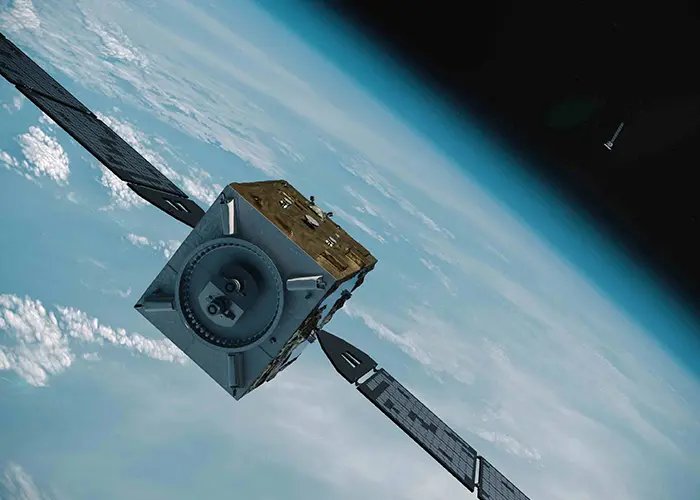
Astroscale Japan Inc., a subsidiary of Astroscale Holdings Inc., has unveiled the client satellites and concept of operations for its ISSA-J1 mission, scheduled for launch in 2027, which will inspect two retired Japanese satellites in orbit.
The company said the mission is intended to advance commercial in-orbit inspection and space situational awareness by maneuvering to and inspecting two satellites in different orbits during a single mission.
“On-orbit inspection provides critical insight into the condition of satellites that cannot be obtained from the ground,” said Nobu Okada, Founder & CEO of Astroscale. “By inspecting multiple objects in different orbits in a single mission, ISSA-J1 will help demonstrate new capabilities that support satellite operators in understanding spacecraft condition and preparing for future servicing.”
Space situational awareness systems are used to track objects and manage collision risk in orbit, but Astroscale said ground-based observations cannot provide detailed information about a satellite’s condition. The company said on-orbit inspection can provide close-range imagery and characterisation data to help operators assess satellite health and make operational decisions.
Astroscale said ISSA-J1 is being developed under Japan’s Small Business Innovation Research Program, specifically the Ministry of Education, Culture, Sports, Science and Technology Phase 3 Fund for large-scale technology demonstrations.
Client satellites
Astroscale said ISSA-J1 will inspect two retired Japanese satellites launched in the early 2000s, observing their condition more than 20 years after launch, including attitude, rotation behaviour and signs of degradation. The company said the mission will conduct close-range observations of multiple objects without making physical contact.
Advanced Land Observing Satellite (ALOS)
- Japanese name: “Daichi”
- Operational period: Jan. 24, 2006 – May 12, 2011
- Dimensions: 6 m x 3.5 m x 4.5 m
- Solar array panel: 22 m × 3 m
- Mass: about 4 metric tons
- Orbital altitude: about 691 km
- Advanced Earth Observing Satellite‑II (ADEOS‑II)
- Japanese name: “Midori‑II”
- Operational period: Dec. 14, 2002 – Oct. 31, 2003
- Dimensions: about 5 m × 4 m × 4 m
- Solar array panel: 24 m × 3 m
- Mass: about 3.7 metric tons
- Orbital altitude: about 803 km – 820 km
Concept of operations
Astroscale said the ISSA-J1 spacecraft will be deployed into Earth orbit after launch and undergo initial system and communication checks before beginning operations. The spacecraft will then adjust its orbit and gradually approach the first client, ALOS.
The company said ISSA-J1 will begin observations from a safe distance while assessing ALOS’ motion and condition, then progressively reduce the distance while maintaining safety, conducting close-range imaging and observation around the satellite without making contact.
After completing the first inspection, Astroscale said ISSA-J1 will depart ALOS’s orbit and transition to a different orbit to reach the second client, ADEOS‑II, through a series of trajectory adjustments, then repeat the approach and inspection process.
ISSA‑J1 spacecraft specifications
- Name: ISSA‑J1 (In‑situ Space Situational Awareness – Japan 1)
- Dimensions: about 1,300 mm × 1,600 mm × 2,200 mm (solar arrays deployed: about 1,300 mm × 10,000 mm × 2,200 mm)
- Mass: about 650 kg (with propellant loaded)
- Thrusters: 12 total
- 10 chemical propulsion thrusters
- 2 electric propulsion thrusters