

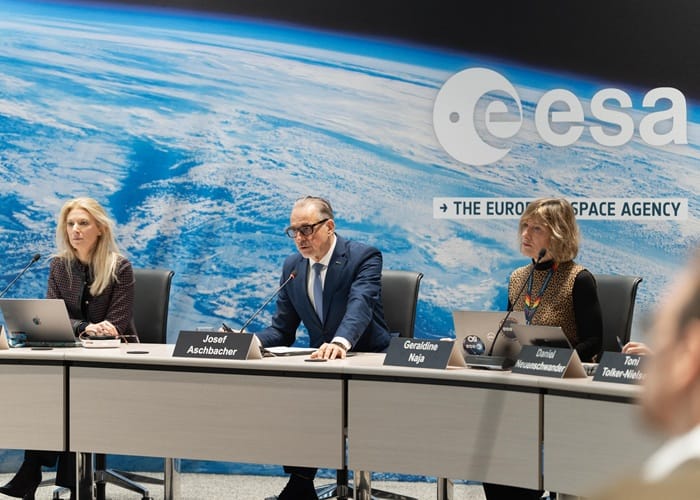
The European Space Agency (ESA) Council has endorsed a new crewed mission concept to the International Space Station, expanded cooperation on planetary defence, and approved leadership changes as part of decisions taken at its 345th meeting.
The meeting was held in Interlaken, Switzerland, from 18 to 19 March 2026. ESA said discussions covered strategic priorities, including the implementation of decisions taken at the agency’s Council meeting at Ministerial level in November 2025 (CM25).
Among the decisions, the Council endorsed the concept of EPIC (ESA Provided Institutional Crew), a proposed mission to the ISS intended to support Europe’s scientific and strategic use of the station in its remaining years. ESA said the concept foresees acquiring a Crew Dragon mission in the first quarter of 2028 for a medium-duration stay on the ISS, in collaboration with interested international partners.
Member States also approved ESA-JAXA cooperation on Ramses, a mission intended to study asteroid Apophis. ESA said Japan’s space agency (JAXA) plans to contribute a thermal infrared imager (TIRI), lightweight solar array wings, and the H3 launcher.
Canada’s participation was approved in several ESA programmes: Accelerating Commercialisation and Competitiveness of the European Space Sector (ACCESS), European Resilience from Space – Earth Observation (ERS‑EO), Moonlight and FutureNAV. ESA said the decision follows Canada’s largest subscription to ESA at CM25 since partnering with the agency in 1979.
On ESA-EU cooperation, Member States reviewed preparations for the EU Multiannual Financial Framework 2028–2034 and noted the status of EU legislative work on the proposed European Competitiveness Fund and the proposed ‘EU Space Act’. ESA said it is ready to act as the technical and system-development agency for the EU Space Programme, and advocated an inclusive approach for EU and ESA Member States.
In space safety, Member States approved collaboration with the Carnegie Institution for Science to host and operate ESA’s FlyEye‑2 telescope at Las Campanas Observatory in Chile, aimed at expanding Europe’s capability to detect and track near-Earth objects.
The Council designated Juan Carlos Cortés Pulido, Head of the Spanish Delegation, as the new Chair of the ESA Council, and Tanja Permozer (Slovenia) and Kimmo Kanto (Finland) as Vice-Chairs. The two-year term starts on 1 July 2026. It also approved the renewal of Carole Mundell as Director of Science and Dietmar Pilz as Director of Technology, Engineering and Quality for second four-year terms running until 28 February 2031 and 30 April 2031, respectively.
On governance and organisational culture, the Council took note of the first Annual Activity Report from the ESA Ethics Ombudsperson, described by ESA as an independent contact point for ethical concerns and advice to management.
The Council also approved for public release two status reports: a Status Report on Space Transportation Programmes and a Status Report on Ground Systems Engineering and Operations.
Separately, ESA Director General Josef Aschbacher signed funding arrangements with the Swedish National Space Agency and the UK Space Agency enabling additional national contributions to the ESA–State Space Agency of Ukraine project fund. ESA said the fund builds on an implementation arrangement signed on 30 October 2025 covering seven demonstrator projects involving Ukrainian scientists, engineers and companies alongside ESA Member States.
Image credit: ESA – D. Dos Santos