

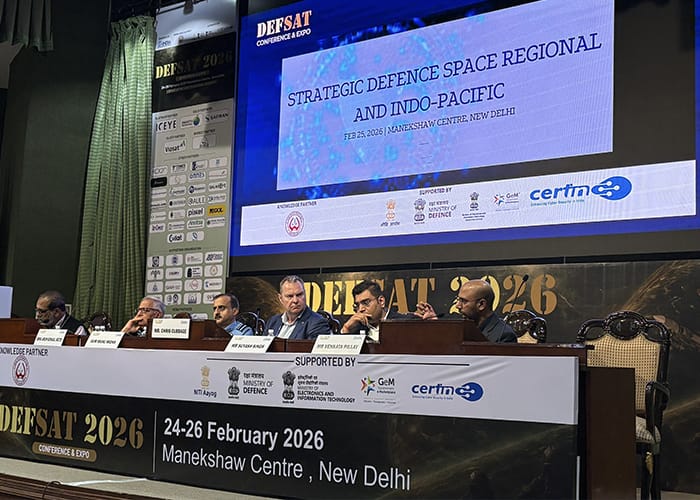
A DefSat Conference 2026 discussion panel this week in New Delhi, jointly organised between SIA-India and Space and Earth Partners and Advisory, titled “Strategic Defence Space: Regional and Indo-Pacific” framed space as a fast-moving security domain where cooperation is desirable but hard to execute, largely because capability is uneven across the region and politics is fragmenting faster than governance can keep up.
Former ambassador Rakesh Sood opened by stressing the sheer diversity of the Indo-Pacific: around 40 countries, including ASEAN members and many small Pacific island states, with space and defence-space capabilities “not uniformly distributed.” In practical terms, he argued, the region’s comprehensive capabilities sit with a handful of actors: India and China as long-standing programs, Japan as a full-spectrum player, and extra-regional powers such as the United States and France operating heavily in the theatre. That imbalance shapes what “defence space cooperation” can realistically mean.
Sood pointed to the Quad as one framework attempting to organise cooperation, noting its 2021 space-related working group objectives: sharing satellite data where possible for maritime monitoring; capacity building for sustainable development; and consultations on norms and guidelines for future capabilities and operations. But he characterised cooperation as still “exploratory,” and suggested two distinct tracks: government-to-government cooperation among strategic partners with useful, exchangeable capabilities; and a separate private sector-to-private sector track driven by startups and small companies, where progress may be faster but requires different enabling conditions.
Air Vice Marshal Manu Midha, Director General of India’s Defence Space Agency (DSA), placed the discussion in a broader “VUCA” environment, describing a fragmented global order where “rules of the road” are being rewritten amid major power rivalry and active conflicts. His argument was that space is no longer a metaphorical “high ground” but an operational reality, increasingly integrated into maritime and aerial theatres and foundational to multi-domain warfare. At the same time, he warned that space activity has outpaced space traffic management and governance mechanisms, while signalling and attribution remain difficult: it can be hard to distinguish deliberate hostile acts from accidents or natural events.
Midha outlined four pillars he sees as practical anchors for cooperation. First, regular communication channels to reduce mistrust and unintended escalation. Second, technology sharing, including high-value ISR data, to move from “isolated sensors” toward a “unified, resilient mesh network” and to reduce duplicated R&D cost while building interoperability by design. Third, sharing tactics, techniques and procedures (TTPs), arguing that in orbital mechanics small timing errors can have catastrophic consequences and “thinking in silos is a liability.” Fourth, making best use of complementary capabilities, because no single nation can sustain the full spectrum of persistence, telemetry and rapid recovery alone; a “system of systems” approach can bridge gaps across partners.
Brigadier Arun Sehgal (Retd) added a sharper threat lens. He described expanding counter-space capabilities by China and Russia, including direct-ascent anti-satellite options, directed energy, jamming and cyber operations, alongside growing capabilities in Iran and North Korea. He highlighted the spread of GPS jamming across conflict zones and its spillover impact on commercial activity such as civil aviation. He also warned about proximity operations (RPO) and the risk of misinterpretation, plus the persistent debris hazard amplified by launch practices that leave long-lived rocket bodies in orbit. His mitigation themes centred on better space situational awareness, regional cyber frameworks for intelligence sharing, debris reduction and removal, and pushing norms that reduce the risk of destructive tests and escalation.
Industry voices pulled the conversation toward execution. Venkat Pillay of LC60ai described operating across borders (Australia, Malaysia, Abu Dhabi and an announced India presence) and argued startups can deliver speed in turning satellite data into operational insights, not only for defence but also for food and maritime security. GalaxEye CEO Suyash Singh emphasised India’s growing cohort of IP-led space startups and said external engagement is shifting from buyer–seller to collaboration. But he also flagged friction points: “friendly foreign nation” alignment remains a grey area, supply chain resilience must be built across trusted partners, and data sharing discussions often stall without clear frameworks.
A key moment came in Q&A on why space governance has not kept pace since the 1967 Outer Space Treaty. Sood’s answer was blunt: politics drives agreements, and today’s major powers lack convergence. The panel’s closing note was to “think small” and build trust through incremental regional cooperation and standardised protocols for information sharing, using practical initiatives rather than waiting for comprehensive global consensus.