
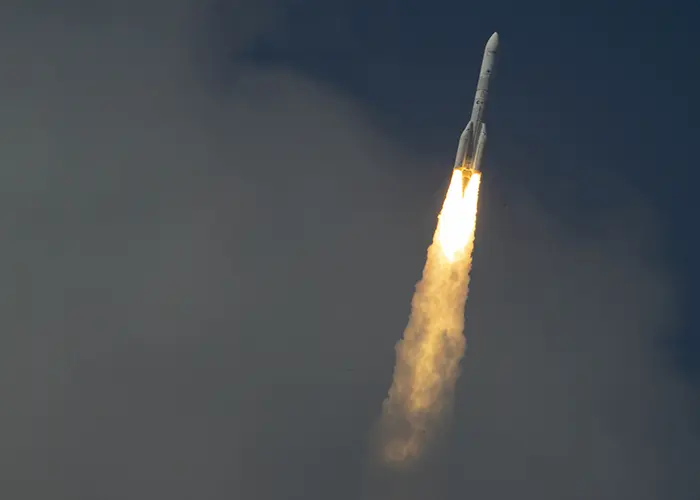
Europe has conducted the first launch of Ariane 6 in its four-booster configuration, marking the debut of the rocket’s most powerful variant.
The launch took place on 12 February 2026 from Europe’s Spaceport in French Guiana, with liftoff at 16:45 GMT (03:45 AEDT (next day)). Operated by Arianespace, the Ariane 64 configuration carried 32 satellites for Amazon’s Leo constellation into low Earth orbit. Deployment of the final satellites occurred 114 minutes after launch.
Ariane 6 is designed to be modular, flying with either two or four P120C solid rocket boosters and different fairing lengths depending on mission requirements. The four-booster version, known as Ariane 64, more than doubles the lift capacity of the two-booster Ariane 62 variant. In this configuration, Ariane 6 can deliver approximately 21.6 tonnes to low Earth orbit, compared with around 10.3 tonnes for the two-booster version.
The P120C boosters are among the most powerful single-piece solid rocket motors currently in production. The mission demonstrated the simultaneous operation of four boosters alongside the main stage under flight conditions.
The rocket used for this mission was the tallest Ariane 6 assembled to date. With a 20-metre fairing housing the 32 satellites, the vehicle stood 62 metres tall.
The upper stage’s auxiliary propulsion unit enabled rapid deployment of the satellite payload. After releasing the satellites, the upper stage performed a third ignition to conduct a controlled deorbit manoeuvre, consistent with Europe’s debris mitigation approach.
European Space Agency officials described the flight as a key step in restoring Europe’s full heavy-lift capability. Ariane 6 now joins Vega-C and Ariane 62 in Europe’s operational launch fleet, providing coverage for a range of payload sizes and orbital destinations.
The development of Ariane 6 involved industrial partners across 13 European countries, led by ArianeGroup as prime contractor. CNES manages launch site operations in French Guiana, while Arianespace serves as launch service provider.
Future upgrades are already in progress. The P120C boosters are scheduled to be replaced by the larger P160C motors, which were tested in April 2025. The upgraded boosters are designed to increase payload performance and competitiveness for both Ariane 6 and Vega launch systems.