

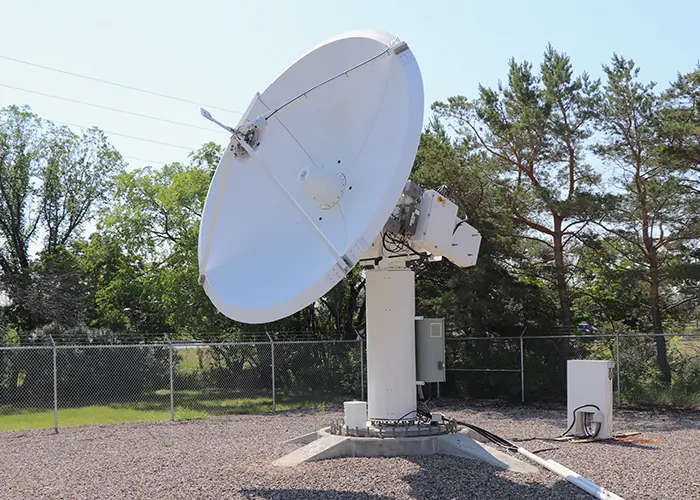
SatService, a German-based satellite ground systems provider and subsidiary of Canada’s Calian Group, has been awarded a contract to deliver a Q/V-band satellite ground station for the German Armed Forces, supporting both scientific research and military communications.
The contract, awarded by Germany’s Federal Ministry of Defence through the University of the Federal Armed Forces in Munich, covers the design, manufacture, testing and delivery of a complete satellite ground station, including a four-metre antenna system. Once operational, the station will support communications with geostationary orbit satellites in the Q/V frequency range, a capability not currently available at the university.
Q/V-band frequencies are attracting increasing interest from European governments and defence organisations as demand for satellite bandwidth grows and traditional frequency bands become more congested. Operating at higher frequencies enables greater data throughput but also introduces technical challenges related to propagation, weather effects and system resilience.
According to SatService, the ground station will form part of the Bundeswehr University Munich’s terrestrial laboratory, enabling research into advanced satellite communications and providing a training platform for German Armed Forces officers. The system is intended to support secure, high-throughput connectivity while giving trainees exposure to the operational characteristics of geostationary satellite communications, including continuous regional coverage and increased capacity.
Beyond education and research, the capability aligns with broader European efforts to strengthen sovereign satellite communications and reduce dependence on external infrastructure. Access to multiple frequency bands is increasingly viewed as critical for resilience, particularly for defence and security applications.
The project also highlights the role of domestic and allied suppliers in delivering specialised ground infrastructure as military space capabilities evolve. While the station is primarily positioned as a research and training asset, it supports command, control, communications, cyber and intelligence functions that underpin modern military operations.
Delivery timelines and operational deployment details were not disclosed.