

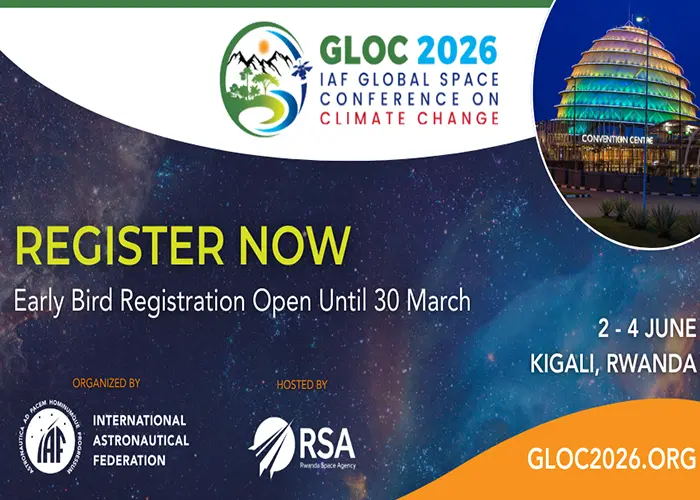
 As climate risks place enormous pressure on regional economies, infrastructure, and communities, the demand for actionable, trusted, and timely climate intelligence has never been greater. From 2 – 4 June 2026, global leaders from space, climate, policy, and finance will gather in Kigali, Rwanda, for the second edition of the IAF Global Space Conference on Climate Change (GLOC 2026) – a high-level forum dedicated to accelerating space-enabled solutions for climate resilience..
Organized by the International Astronautical Federation (IAF) and hosted by the Rwanda Space Agency (RSA), GLOC 2026 is held under the theme “Uniting Space and Earth for Climate Resilience”. The Conference will demonstrate how space-based data, services, and technologies are rapidly becoming essential infrastructure for climate adaptation, disaster risk reduction, sustainable development, and green finance.
Building on the outcomes of GLOC 2023 in Oslo, Norway, this second edition will provide a comprehensive update on global progress, highlight concrete use cases, and shape the next phase of international cooperation. Participants are invited not only to learn from leading initiatives, but also to commit to partnerships, investment, and implementation that translate satellite data into measurable climate impact.
 GLOC 2026 is expected to attract a wide spectrum of participants , including Heads of State, ministers, senior officials of major space agencies, industry leaders, development partners, investors, scientists, astronauts, and innovators, major financial institutions and the civil society. The Conference will kick-off with a High-Level Opening Ceremony and inauguration of the Exhibition.
A Plenary Programme will follow, featuring high-level panel discussions addressing strategic priorities at the intersection of space, climate policy, technology, and finance, including:
- Global Access, Global Impact – Democratizing Space Data
- Smart Systems, Sustainable Choices – Building Responsible AI for Space Applications
- Financing the Planet – How Space Data Powers the Next Era of Green Investment
In addition, the broader technical programme will address key thematic areas, including:
- Climate Adaptation and Resilience
- Greenhouse Gas Monitoring and Impact Assessment
- Big Data, AI, Machine Learning, Digital Innovation, and Green Energy Solutions
- Service Development and Data Access
- Disaster Risk Reduction and Emergency Management
- Good Governance, Climate Policy, and the Sustainable Development Goals
- Technology, Innovation, and Industrial Development
- Economy, Finance, and Investment for Climate Goals
- Outreach, Education, Capacity Building, and International Collaboration
The response to the Call for Abstracts for the GLOC 2026 Technical Programme has been exceptional. A total of 318 abstracts were submitted from 59 countries across all continents reviewed by the largest and most diverse International Programme Committee (IPC to date – bringing together 118 experts from across the space, climate, and policy communities.
 Authors of selected presentations will have the opportunity to participate in the prestigious IP Competition, recognizing outstanding contributions which advance space-enabled climate action.
Rwanda’s role as the GLOC 2026 Host country reflects its growing leadership in science, innovation, and sustainability.
- Space-based data is already supporting food security and sustainable economic growth in Rwanda, enabling precision agriculture, soil conservation, crop diversification, and early detection of pests and diseases.
- Rwanda has achieved 97% nationwide 4G LTE coverage, one of the highest connectivity rates in Africa, providing a strong digital foundation for data-driven climate services.
- Kigali is internationally recognized as one of Africa’s cleanest and safest cities, reflecting Rwanda’s long-standing commitment to environmental stewardship and good governance.
- Nestled in the heart of Africa, Rwanda is a true gem waiting to be explored. Often called “the land of a thousand hills,” this breathtaking destination offers rolling green landscapes, vibrant culture, and a spirit of sustainability that sets it apart as the most eco-friendly country on the African continent.
- Within short distances of the capital, visitors can experience Volcanoes National Park, Akagera National Park, and Lake Kivu, highlighting the country’s unique blend of biodiversity, conservation, and sustainable tourism.
These attributes position Rwanda not only as host, but a living case study of how policy, technology, and environmental responsibility can work together to support climate resilience.
Designed as a catalyst for partnerships, investment, and action, GLOC 2026 reinforces a shared message: space is no longer a frontier for a few, but a shared infrastructure for climate resilience.
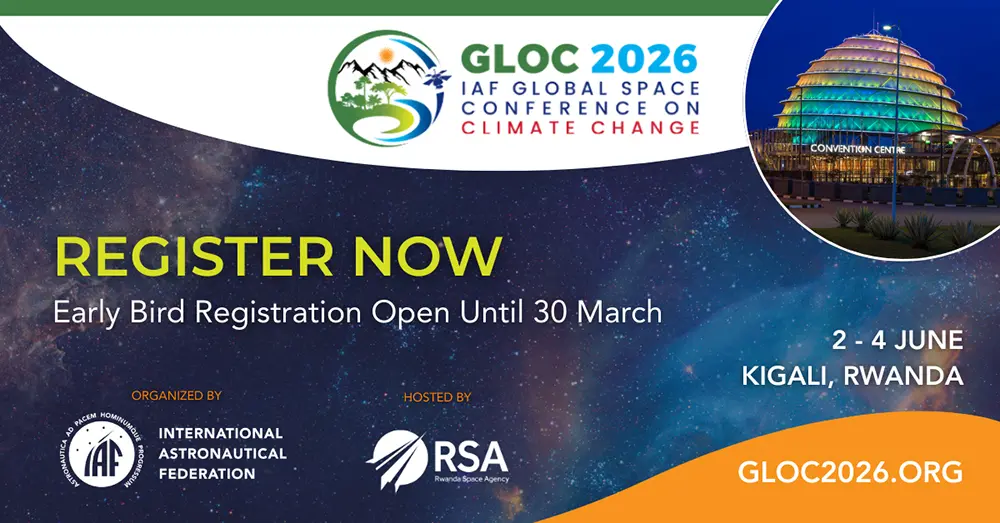
Register early to secure your place at GLOC 2026 and benefit from early-bird registration until 30 March 2026, and join global space community in Kigali, Rwanda, from 2 – 4 June 2026, where ambition meets implementation – uniting space and Earth for a climate-resilient future.