

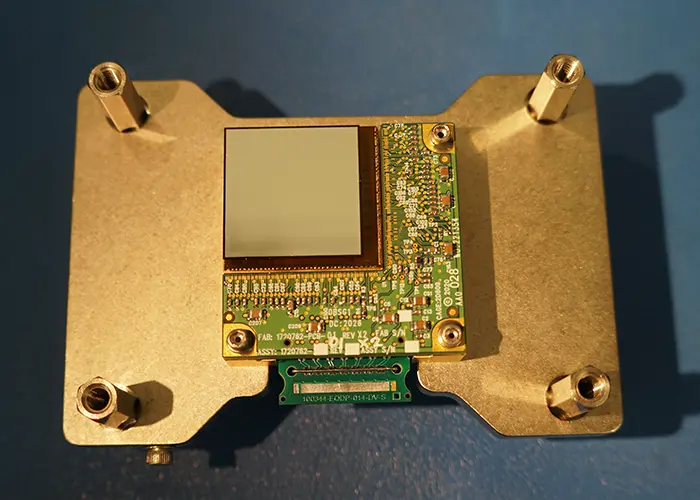
Teledyne Technologies has confirmed the successful launch and deployment of its Speedster HyViSI detectors aboard NASA’s BlackCAT CubeSat mission, which lifted off on 11 January 2026 as part of SpaceX’s “Twilight” rideshare launch.
The detectors, developed by Teledyne’s Space Imaging division, form the focal plane array at the core of BlackCAT’s X-ray instrument. Arranged in a 2×2 mosaic, the Speedster HyViSI focal plane arrays enable the CubeSat to function as an X-ray observatory, capable of detecting transient X-ray events and studying bursts produced by the collapse of early stars into black holes, providing new insights into the early universe.
BlackCAT is led by Pennsylvania State University and demonstrates how advanced X-ray science can be conducted from a compact CubeSat platform. The mission relies on the sensitivity and efficiency of Teledyne’s hybrid CMOS detector technology to observe some of the universe’s most energetic phenomena.
The Speedster HyViSI detector is based on a silicon PIN hybrid CMOS architecture, optimised for soft X-ray detection. Its design combines high quantum efficiency with event-driven fast readout, low power consumption and radiation-hardened performance, making it well suited for space-based X-ray astronomy.
Dr Yibin Bai, Director of Focal Plane Array Development at Teledyne, said X-ray detection represents a natural extension of the company’s HyViSI technology. He noted that the adaptability of the CMOS architecture and the advanced absorber design position the Speedster HyViSI as a high-performance alternative to traditional X-ray sensors used in space missions.
Teledyne Space Imaging designs and manufactures advanced electronics, imaging systems and sensors for use across the global space economy, supporting scientific, commercial and government missions in Earth orbit and beyond.