

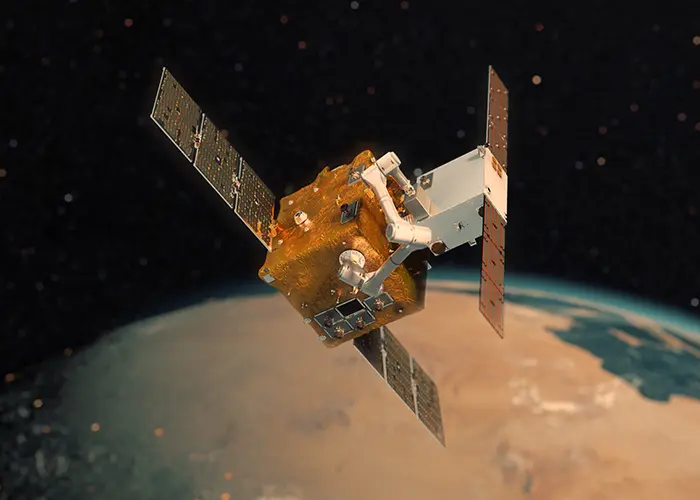
Astroscale UK has been awarded a €399,000 (approximately AUD 700,000) Phase A contract by the European Space Agency to develop a mission concept for what is expected to be the world’s first in-orbit refurbishment and upgrading service, a move that could significantly extend satellite lifetimes and reduce orbital debris.
The eight-month study, known as the In-Orbit Refurbishment and Upgrading Service (IRUS), will be led by Astroscale Limited’s UK subsidiary and supported by spacecraft manufacturer and operator BAE Systems, which will act as a prospective future customer. The project sits within ESA’s Space Safety Programme and supports the agency’s long-term goal of becoming space-debris neutral by 2040.
IRUS aims to enable satellites already in orbit to be repaired, refurbished and technologically upgraded, rather than replaced at end of life. The concept includes the potential replacement of ageing or obsolete subsystems such as batteries, solar arrays and onboard computers, allowing operators to benefit from technology advances made years after launch.
Astroscale said the capability would represent a major step toward a circular space economy, reducing the need for replacement launches while lowering the risk of generating additional debris. The work will also assess the commercial viability of in-orbit refurbishment services, alongside the technical feasibility of safely docking with and servicing operational spacecraft.
The mission concept will build on Astroscale’s rendezvous and proximity operations technology, which has already been demonstrated in orbit, and is seen as a precursor to more advanced in-orbit servicing, assembly and manufacturing missions. The initial demonstration concept is expected to focus on a modular satellite platform developed by BAE Systems, highlighting how satellites could be designed from the outset to support future upgrades in space.
Astroscale UK managing director Nick Shave said the contract marked an important milestone in developing sustainable space infrastructure, with benefits for both civil and defence space activities. BAE Systems said the project demonstrated how dual-use innovation could improve resilience, reduce launch demand and support long-term orbital sustainability.
ESA said the study aligns with its 2040 strategy and is intended to position European industry at the forefront of sustainable orbital operations, while laying the foundations for future in-orbit servicing and manufacturing missions.
The project is also expected to strengthen UK capability in robotics, modular spacecraft design and servicing systems, supporting high-value jobs and reinforcing the country’s role in the emerging global market for in-orbit services.