
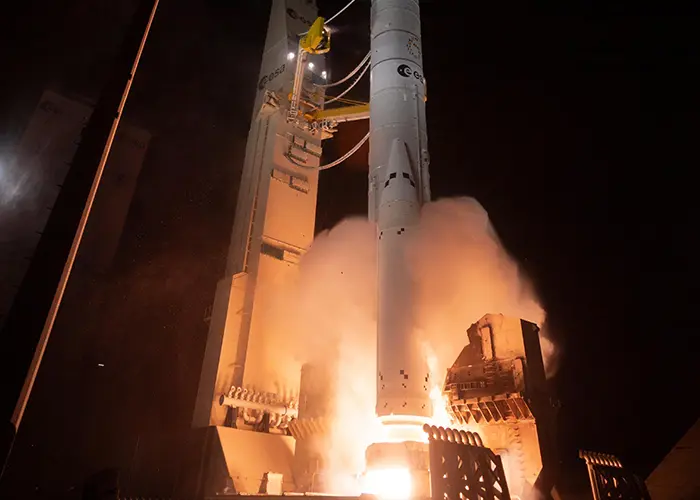
Two Galileo satellites were successfully launched on 17 December from Europe’s Spaceport in French Guiana aboard an Ariane 6 rocket, marking the first Galileo mission to fly on Europe’s new heavy-lift launcher and the 14th launch for the Galileo navigation programme.
The satellites, designated SAT 33 and SAT 34, lifted off at 4:01 pm AEDT and separated from the launcher after a flight lasting just under four hours. At 8:51 pm AEDT, the mission was declared successful following confirmation of signal acquisition, satellite health and deployment of solar arrays.
The spacecraft are now undergoing early operations and in-orbit testing before entering service in medium Earth orbit at an altitude of approximately 23,222 kilometres. Once operational, they will increase the number of active Galileo satellites to 29, strengthening coverage, redundancy and service continuity across the constellation.
Galileo has been providing global navigation services since entering service in 2016 and continues to evolve its capabilities. One of its key offerings is the High Accuracy Service, operational since 2023, which delivers centimetre-level positioning accuracy for authorised users equipped with dedicated receivers.
The addition of the two satellites further reinforces the constellation’s ability to deliver continuous positioning, navigation and timing services to civil, commercial and government users worldwide. Galileo underpins a wide range of applications, including transport, emergency services, telecommunications, energy networks and security-related operations.
The mission represents Galileo’s first launch aboard Ariane 6 and the fifth launch overall for the new European launcher. Two additional launches carrying first-generation Galileo satellites are planned, ahead of the transition to Galileo Second Generation spacecraft, which are expected to introduce enhanced resilience and new service capabilities.
European Space Agency Director General Josef Aschbacher said the mission demonstrated Europe’s ability to independently design, build, launch and operate critical space infrastructure, highlighting the importance of autonomous access to space for long-term resilience.
ESA’s Director of Navigation, Francisco-Javier Benedicto Ruiz, said the launch brings the programme closer to completing its first-generation constellation, while preparations continue for the deployment of second-generation satellites.
ESA’s Director of Space Transportation, Toni Tolker-Nielsen, said Ariane 6 will serve as the reference launcher for Galileo missions, building on the role previously played by Ariane 5.
Image: Galileo launch 14 liftoff – Credits: ESA – S. Corvaja